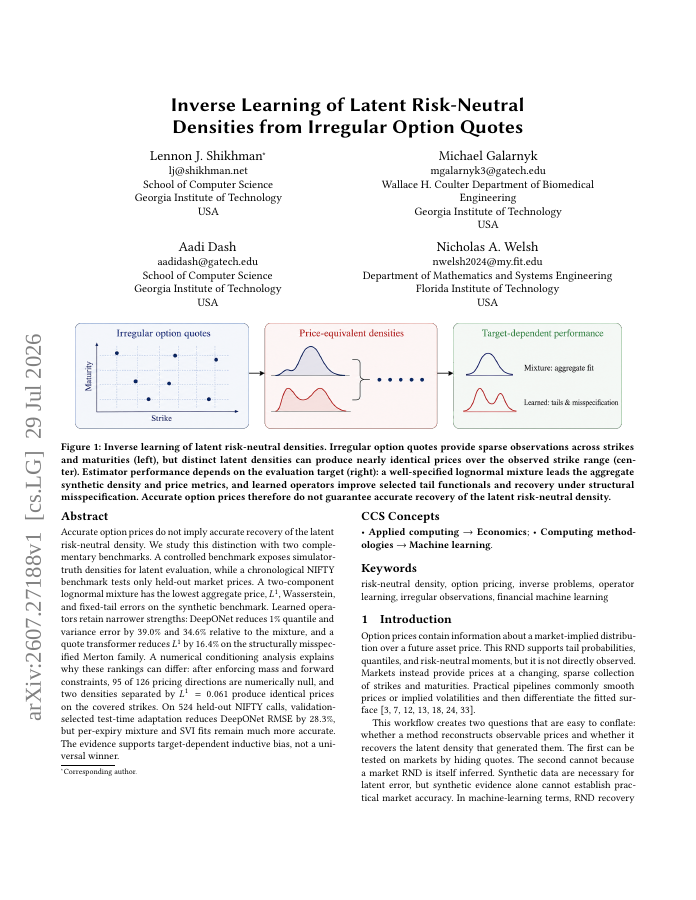
Accurate option prices do not imply accurate recovery of the latent risk-neutral density. We study this distinction with two complementary benchmarks. A controlled benchmark exposes simulator-truth densities for latent evaluation, while a chronological NIFTY benchmark tests only held-out market prices. A two-component lognormal mixture has the lowest aggregate price, L^1, Wasserstein, and fixed-tail errors on the synthetic benchmark. Learned operators retain narrower strengths: DeepONet reduces 1% quantile and variance error by 39.0% and 34.6% relative to the mixture, and a quote transformer reduces L^1 by 16.4% on the structurally misspecified Merton family. A numerical conditioning analysis explains why these rankings can differ: after enforcing mass and forward constraints, 95 of 126 pricing directions are numerically null, and two densities separated by L^1 = 0.061 produce identical prices on the covered strikes. On 524 held-out NIFTY calls, validation-selected test-time adaptation reduces DeepONet RMSE by 28.3%, but per-expiry mixture and SVI fits remain much more accurate. The evidence supports target-dependent inductive bias, not a universal winner.
Inverse Learning of Latent Risk-Neutral Densities from Irregular Option Quotes
Accurate option prices do not imply accurate recovery of the latent risk-neutral density. We study this distinction with two complementary benchmarks. A controlled benchmark exposes simulator-truth densities for latent evaluation, while a chronological NIFTY benchmark tests only…
- Preview
- Year
- 2026
- Hosting
- Abstract onlyARXIV-DEFAULT
Cite
Notes
Only stored in your browser.
Attribution
- Abstract & full text
- arxiv.org/abs/2607.27188ARXIV-DEFAULT
- TL;DR
- Semantic Scholar