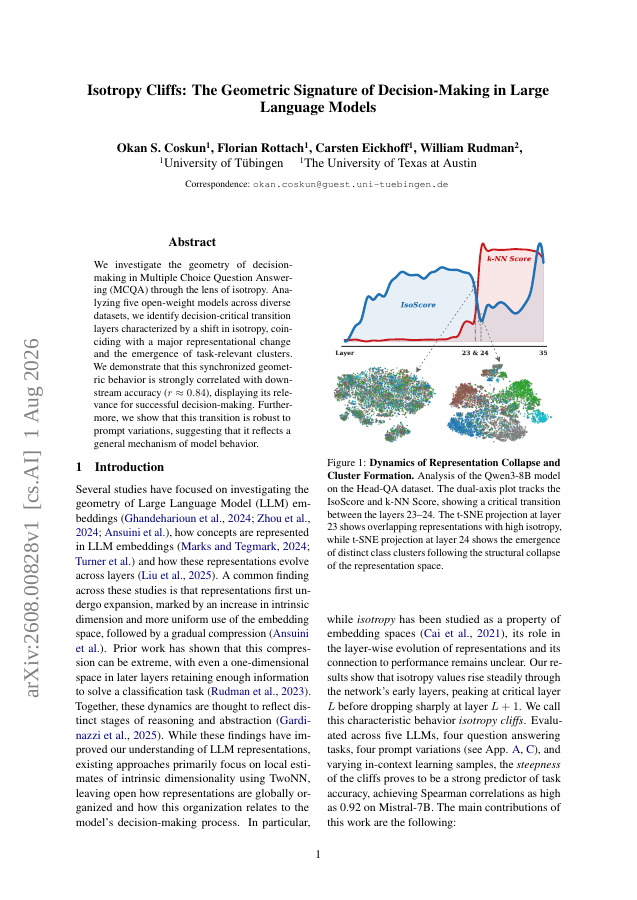
We investigate the geometry of decision-making in Multiple Choice Question Answering (MCQA) through the lens of isotropy. Analyzing five open-weight models across diverse datasets, we identify decision-critical transition layers characterized by a shift in isotropy, coinciding with a major representational change and the emergence of task-relevant clusters. We demonstrate that this synchronized geometric behavior is strongly correlated with downstream accuracy (r\approx0.84), displaying its relevance for successful decision-making. Furthermore, we show that this transition is robust to prompt variations, suggesting that it reflects a general mechanism of model behavior.
Isotropy Cliffs: The Geometric Signature of Decision-Making in Large Language Models
We investigate the geometry of decision-making in Multiple Choice Question Answering (MCQA) through the lens of isotropy. Analyzing five open-weight models across diverse datasets, we identify decision-critical transition layers characterized by a shift in isotropy, coinciding…
- Preview
- Year
- 2026
- Hosting
- Abstract onlyARXIV-DEFAULT
Cite
Notes
Only stored in your browser.
Attribution
- Abstract & full text
- arxiv.org/abs/2608.00828ARXIV-DEFAULT
- TL;DR
- Semantic Scholar