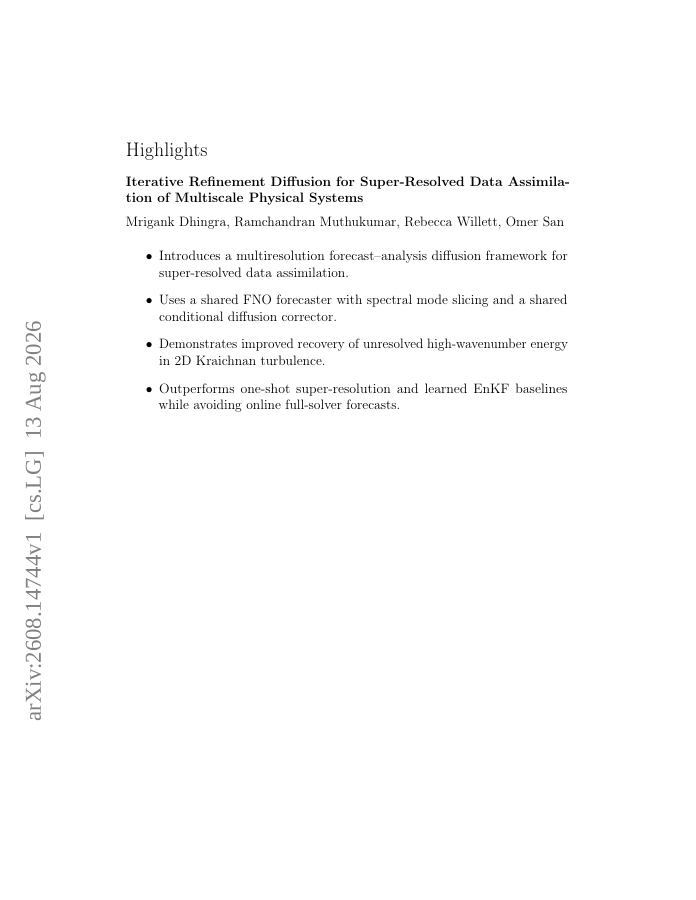
Recovering high-resolution states from sparse, low-resolution observations is a central challenge in scientific machine learning and data assimilation. Classical data assimilation exploits temporal information through forecast-analysis cycles, but often requires repeated access to expensive high-resolution forecast models. Generative super-resolution can recover unresolved structure from coarse observations, but is commonly used as a one-shot mapping that does not fully exploit constraints from past states. We introduce Iterative Refinement (IR), a learned data assimilation framework that combines these perspectives. Instead of performing a single coarse-to-fine reconstruction, IR decomposes the task into resolution-wise forecast-analysis operations across a multiresolution hierarchy. At each stage, a shared neural operator with resolution-dependent spectral mode slicing provides a dynamical prior, while a shared conditional diffusion corrector uses the current coarser-resolution state to produce a refined posterior at the next finer resolution. We evaluate IR on one-dimensional stochastically forced Burgers dynamics and two-dimensional Kraichnan turbulence. On the challenging 256x256 Kraichnan benchmark, IR achieves an RMSE of 0.184 and an SSIM of 0.836, outperforming spectral upsampling, one-shot diffusion super-resolution, enhanced deep super-resolution, and an autoregressive forecaster. On the more constrained Burgers testbed, IR remains competitive with one-shot diffusion, which achieves the lowest RMSE. These results show that one-shot generative reconstruction can be effective for simpler settings, while hierarchical forecast-analysis refinement becomes advantageous in strongly multiscale and underdetermined regimes. Overall, IR combines temporal priors, generative correction, and multiresolution reconstruction for learned data assimilation in complex physical systems.
Iterative Refinement Diffusion for Super-Resolved Data Assimilation of Multiscale Physical Systems
Recovering high-resolution states from sparse, low-resolution observations is a central challenge in scientific machine learning and data assimilation. Classical data assimilation exploits temporal information through forecast-analysis cycles, but often requires repeated access…
- Preview
- Year
- 2026
- Hosting
- Full text hostedCC-BY-4.0
Cite
Notes
Only stored in your browser.
Attribution
- Abstract & full text
- arxiv.org/abs/2608.14744CC-BY-4.0
- TL;DR
- Semantic Scholar