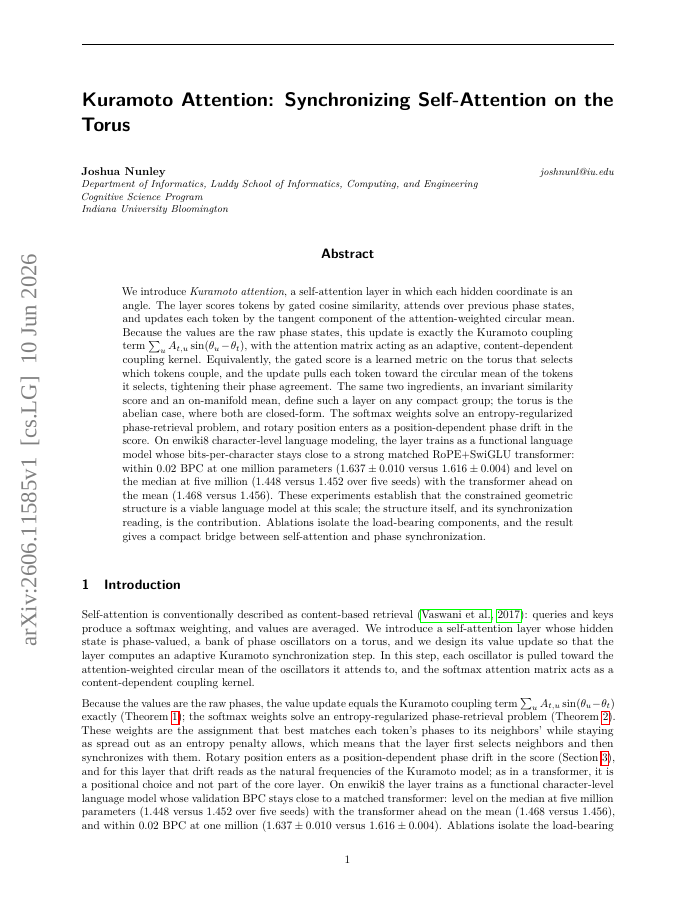
Transformer models are increasingly used as computational models of cognition and neural representation, so the mechanism implemented by self-attention is of interest beyond engineering performance. A complementary tradition in cognitive science models coordination, binding, and memory through dynamical interactions such as oscillator synchrony; we bring this mechanism into self-attention by introducing the Kuramoto Attention layer, whose value update is a synchronization step. Each token carries a bank of phase oscillators, so its hidden state lives on a high-dimensional torus. The attention weights form an adaptive coupling graph, and using the raw phase states as values makes the value update exactly the Kuramoto coupling direction for fixed attention weights. The softmax selects which oscillators couple, while the value path moves each token toward the attention-weighted circular mean of the tokens it selects. We train Kuramoto Attention on enwiki8 and CodeParrot against parameter-matched RoPE and SwiGLU transformers. At 5M parameters on CodeParrot, it improves on the transformer by both median and mean, with mean gaps of 0.012 validation and 0.010 test bits per byte. At 5M on enwiki8, all six runs have lower validation/test medians than the transformer and all-seed means within 0.01 BPC; five of six also form a tight lower-mean cluster. At 1M, it trails by about 0.02 BPC on enwiki8 and by 0.013-0.015 bits per byte on CodeParrot. Ablations and phase diagnostics show how the layer's synchronization and geometry-motivated components shape model performance. The result is a self-attention mechanism whose learned computation can be read directly as adaptive synchronization on phase states.
Kuramoto Attention: Synchronizing Self-Attention on the Torus
Transformer models are increasingly used as computational models of cognition and neural representation, so the mechanism implemented by self-attention is of interest beyond engineering performance.
- Preview
- Year
- 2026
- Hosting
- Full text hostedCC-BY-4.0
Cite
Notes
Only stored in your browser.
Attribution
- Abstract & full text
- arxiv.org/abs/2606.11585CC-BY-4.0
- TL;DR
- Semantic Scholar