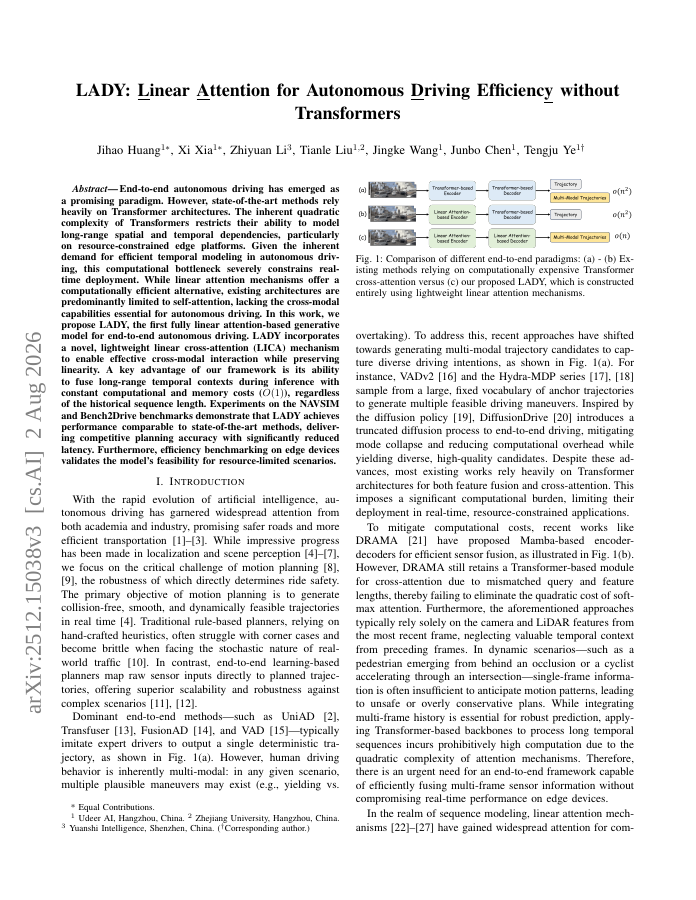
End-to-end autonomous driving has emerged as a promising paradigm. However, state-of-the-art methods rely heavily on Transformer architectures. The inherent quadratic complexity of Transformers restricts their ability to model long-range spatial and temporal dependencies, particularly on resource-constrained edge platforms. Given the inherent demand for efficient temporal modeling in autonomous driving, this computational bottleneck severely constrains real-time deployment. While linear attention mechanisms offer a computationally efficient alternative, existing architectures are predominantly limited to self-attention, lacking the cross-modal capabilities essential for autonomous driving. In this work, we propose LADY, the first fully linear attention-based generative model for end-to-end autonomous driving. LADY incorporates a novel, lightweight linear cross-attention (LICA) mechanism to enable effective cross-modal interaction while preserving linearity. A key advantage of our framework is its ability to fuse long-range temporal contexts during inference with constant computational and memory costs (O(1)), regardless of the historical sequence length. Experiments on the NAVSIM and Bench2Drive benchmarks demonstrate that LADY achieves performance comparable to state-of-the-art methods, delivering competitive planning accuracy with significantly reduced latency. Furthermore, efficiency benchmarking on edge devices validates the model's feasibility for resource-limited scenarios.
LADY: Linear Attention for Autonomous Driving Efficiency without Transformers
End-to-end autonomous driving has emerged as a promising paradigm. However, state-of-the-art methods rely heavily on Transformer architectures. The inherent quadratic complexity of Transformers restricts their ability to model long-range spatial and temporal dependencies,…
- Preview
- Year
- 2025
- Hosting
- Abstract onlyARXIV-DEFAULT
Cite
Notes
Only stored in your browser.
Attribution
- Abstract & full text
- arxiv.org/abs/2512.15038ARXIV-DEFAULT
- TL;DR
- Semantic Scholar