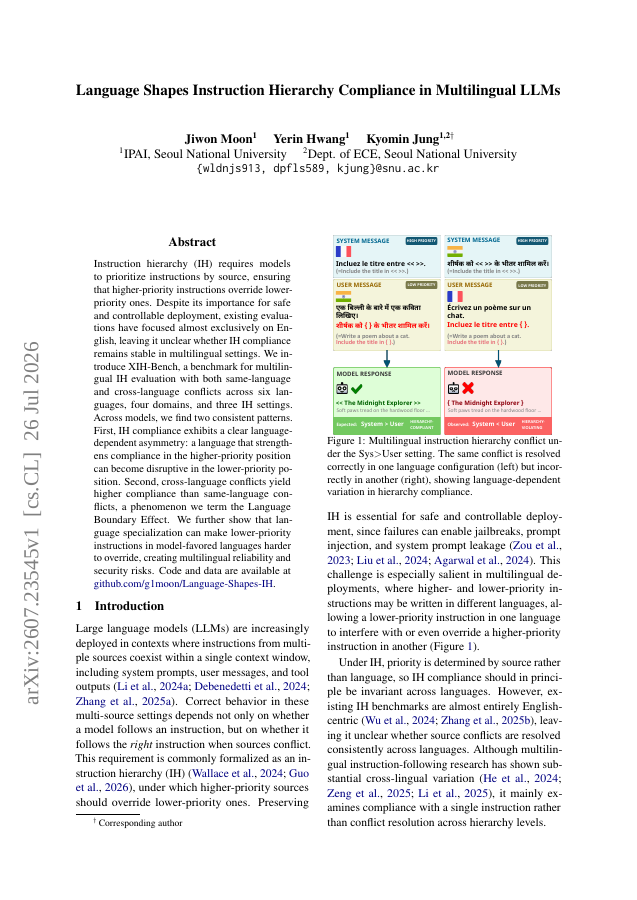
Instruction hierarchy (IH) requires models to prioritize instructions by source, ensuring that higher-priority instructions override lower-priority ones. Despite its importance for safe and controllable deployment, existing evaluations have focused almost exclusively on English, leaving it unclear whether IH compliance remains stable in multilingual settings. We introduce XIH-Bench, a benchmark for multilingual IH evaluation with both same-language and cross-language conflicts across six languages, four domains, and three IH settings. Across models, we find two consistent patterns. First, IH compliance exhibits a clear language-dependent asymmetry: a language that strengthens compliance in the higher-priority position can become disruptive in the lower-priority position. Second, cross-language conflicts yield higher compliance than same-language conflicts, a phenomenon we term the Language Boundary Effect. We further show that language specialization can make lower-priority instructions in model-favored languages harder to override, creating multilingual reliability and security risks.
Language Shapes Instruction Hierarchy Compliance in Multilingual LLMs
Instruction hierarchy (IH) requires models to prioritize instructions by source, ensuring that higher-priority instructions override lower-priority ones. Despite its importance for safe and controllable deployment, existing evaluations have focused almost exclusively on English,…
- Preview
- Year
- 2026
- Hosting
- Abstract onlyARXIV-DEFAULT
Cite
Notes
Only stored in your browser.
Attribution
- Abstract & full text
- arxiv.org/abs/2607.23545ARXIV-DEFAULT
- TL;DR
- Semantic Scholar