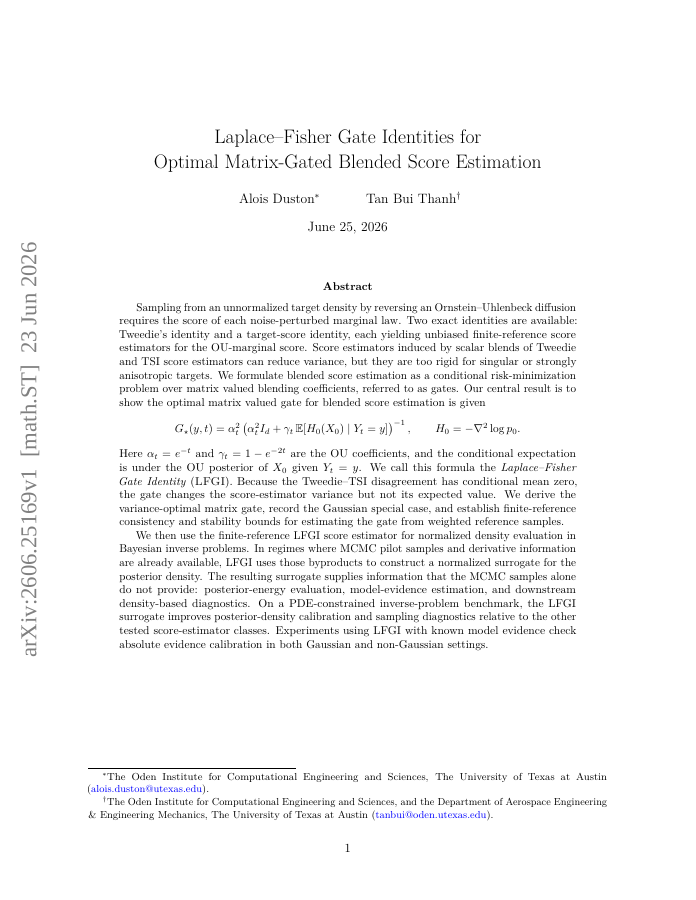
Sampling from an unnormalized target density by reversing an Ornstein-Uhlenbeck diffusion requires the score of each noise-perturbed marginal law. Two exact identities are available: Tweedie's identity and a target-score identity, each yielding unbiased finite-reference score estimators for the OU-marginal score. Score estimators induced by scalar blends of Tweedie and TSI score estimators can reduce variance, but they are too rigid for singular or strongly anisotropic targets. We formulate blended score estimation as a conditional risk-minimization problem over matrix valued blending coefficients, referred to as gates. Our central result is to show the optimal matrix valued gate for blended score estimation is given [ G_\star(y,t) = α_t^2 \left(α_t^2 I_d + γ_t, \mathbb{E}[H_0(X_0)\mid Y_t=y] \right)^{-1}, \qquad H_0=-\nabla^2\log p_0 .] Here α_t = e^{-t} and γ_t = 1-e^{-2t} are the OU coefficients, and the conditional expectation is under the OU posterior of X_0 given Y_t=y. We call this formula the Laplace-Fisher Gate Identity (\LFGI{}). Because the Tweedie-TSI disagreement has conditional mean zero, the gate changes the score-estimator variance but not its expected value. We derive the variance-optimal matrix gate, record the Gaussian special case, and establish finite-reference consistency and stability bounds for estimating the gate from weighted reference samples. We then use the finite-reference LFGI score estimator for normalized density evaluation in Bayesian inverse problems. In regimes where MCMC pilot samples and derivative information are already available, LFGI uses those byproducts to construct a normalized surrogate for the posterior density. The resulting surrogate supplies information that the MCMC samples alone do not provide: posterior-energy evaluation, model-evidence estimation, and downstream density-based diagnostics. On a PDE-constrained inverse-problem benchmark, the LFGI surrogate improves posterior-density calibration and sampling diagnostics relative to the other tested score-estimator classes. Experiments using LFGI with known model evidence check absolute evidence calibration in both Gaussian and non-Gaussian settings.
Laplace-Fisher Gate Identities for Optimal Matrix-Gated Blended Score Estimation
Sampling from an unnormalized target density by reversing an Ornstein-Uhlenbeck diffusion requires the score of each noise-perturbed marginal law. Two exact identities are available: Tweedie's identity and a target-score identity, each yielding unbiased finite-reference score…
- Preview
- Year
- 2026
- Hosting
- Full text hostedCC0
Cite
Notes
Only stored in your browser.