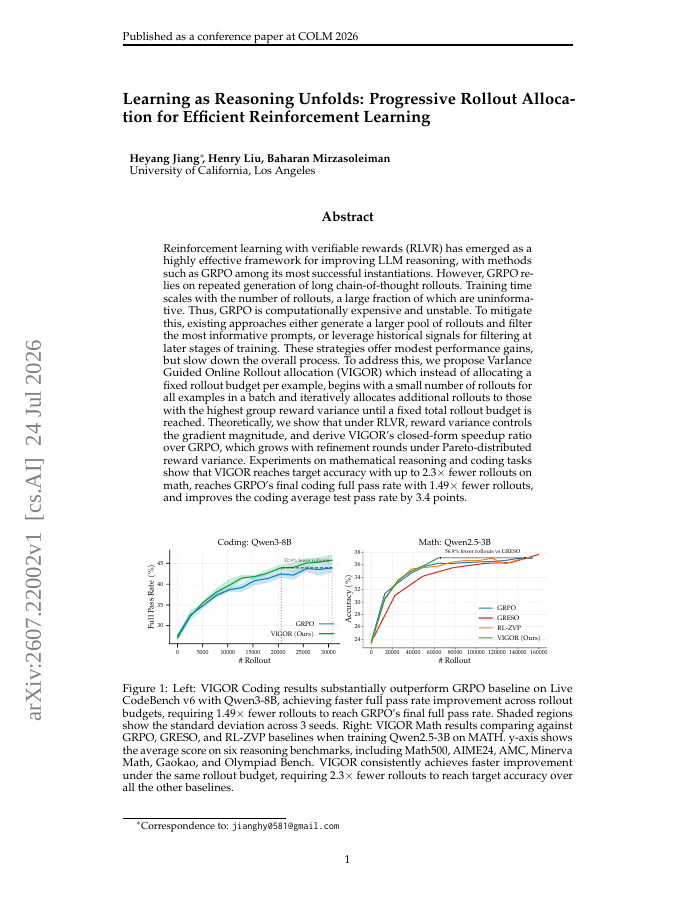
Reinforcement learning with verifiable rewards (RLVR) has emerged as a highly effective framework for improving LLM reasoning, with methods such as GRPO among its most successful instantiations. However, GRPO relies on repeated generation of long chain-of-thought rollouts. Training time scales with the number of rollouts, a large fraction of which are uninformative. Thus, GRPO is computationally expensive and unstable. To mitigate this, existing approaches either generate a larger pool of rollouts and filter the most informative prompts, or leverage historical signals for filtering at later stages of training. These strategies offer modest performance gains, but slow down the overall process. To address this, we propose VarIance Guided Online Rollout allocation (VIGOR) which instead of allocating a fixed rollout budget per example, begins with a small number of rollouts for all examples in a batch and iteratively allocates additional rollouts to those with the highest group reward variance until a fixed total rollout budget is reached. Theoretically, we show that under RLVR, reward variance controls the gradient magnitude, and derive VIGOR's closed-form speedup ratio over GRPO, which grows with refinement rounds under Pareto-distributed reward variance. Experiments on mathematical reasoning and coding tasks show that VIGOR reaches target accuracy with up to 2.3\times fewer rollouts on math, reaches GRPO's final coding full pass rate with 1.49\times fewer rollouts, and improves the coding average test pass rate by 3.4 points.
Learning as Reasoning Unfolds: Progressive Rollout Allocation for Efficient Reinforcement Learning
Reinforcement learning with verifiable rewards (RLVR) has emerged as a highly effective framework for improving LLM reasoning, with methods such as GRPO among its most successful instantiations. However, GRPO relies on repeated generation of long chain-of-thought rollouts.
- Preview
- Year
- 2026
- Hosting
- Full text hostedCC-BY-4.0
Cite
Notes
Only stored in your browser.
Attribution
- Abstract & full text
- arxiv.org/abs/2607.22002CC-BY-4.0
- TL;DR
- Semantic Scholar