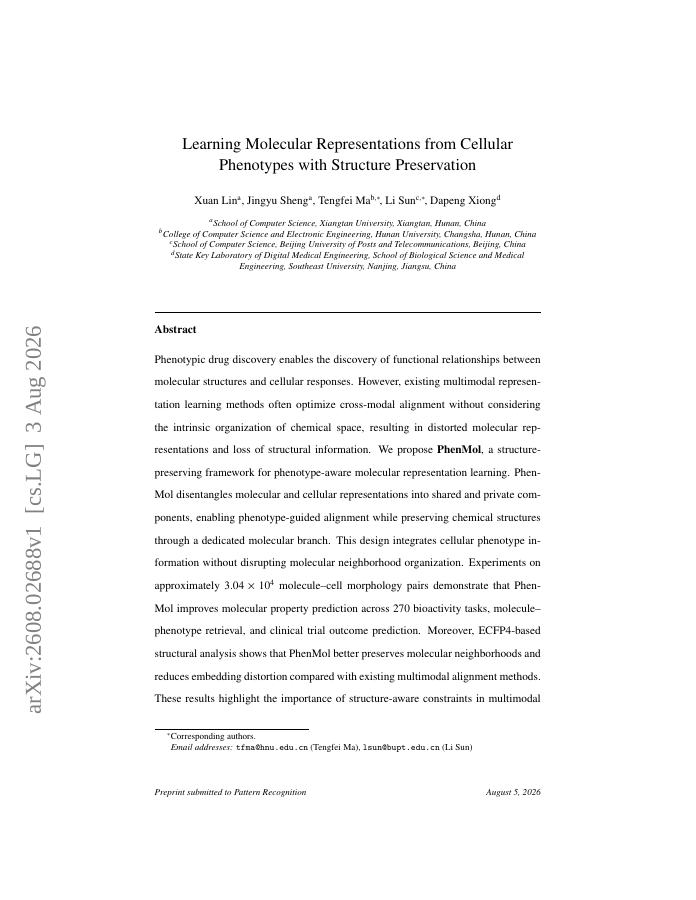
Phenotypic drug discovery enables the discovery of functional relationships between molecular structures and cellular responses. However, existing multimodal representation learning methods often optimize cross-modal alignment without considering the intrinsic organization of chemical space, resulting in distorted molecular representations and loss of structural information. We propose PhenMol, a structure-preserving framework for phenotype-aware molecular representation learning. PhenMol disentangles molecular and cellular representations into shared and private components, enabling phenotype-guided alignment while preserving chemical structures through a dedicated molecular branch. This design integrates cellular phenotype information without disrupting molecular neighborhood organization. Experiments on approximately 3.04 \times 10^{4} molecule--cell morphology pairs demonstrate that PhenMol improves molecular property prediction across 270 bioactivity tasks, molecule--phenotype retrieval, and clinical trial outcome prediction. Moreover, ECFP4-based structural analysis shows that PhenMol better preserves molecular neighborhoods and reduces embedding distortion compared with existing multimodal alignment methods. These results highlight the importance of structure-aware constraints in multimodal molecular representation learning and provide an effective approach for integrating cellular phenotypes with chemical knowledge for drug discovery.
Learning Molecular Representations from Cellular Phenotypes with Structure Preservation
Phenotypic drug discovery enables the discovery of functional relationships between molecular structures and cellular responses. However, existing multimodal representation learning methods often optimize cross-modal alignment without considering the intrinsic organization of…
- Preview
- Year
- 2026
- Hosting
- Abstract onlyARXIV-DEFAULT
Cite
Notes
Only stored in your browser.
Attribution
- Abstract & full text
- arxiv.org/abs/2608.02688ARXIV-DEFAULT
- TL;DR
- Semantic Scholar