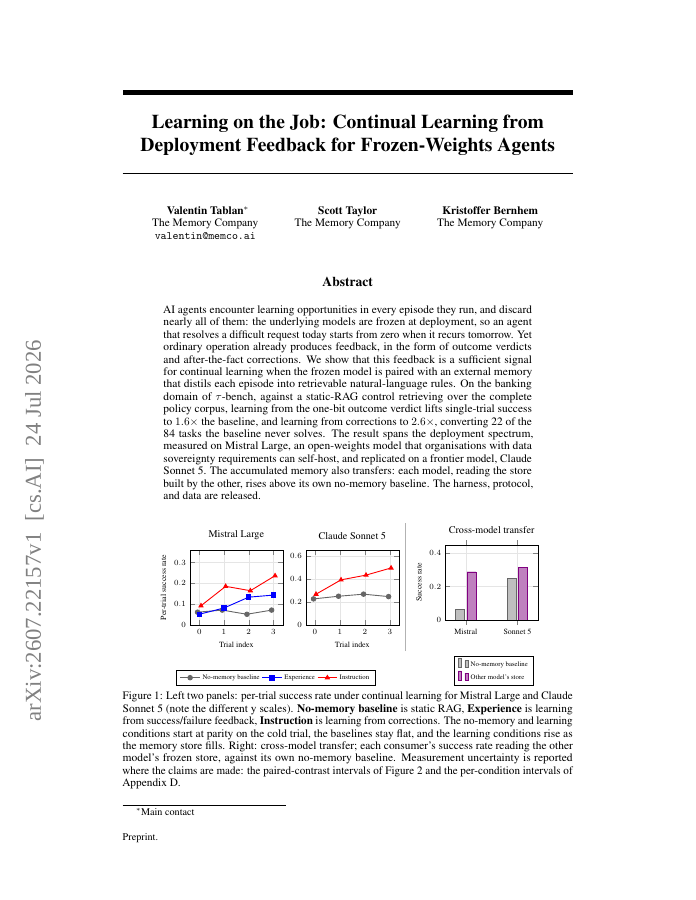
AI agents encounter learning opportunities in every episode they run, and discard nearly all of them: the underlying models are frozen at deployment, so an agent that resolves a difficult request today starts from zero when it recurs tomorrow. Yet ordinary operation already produces feedback, in the form of outcome verdicts and after-the-fact corrections. We show that this feedback is a sufficient signal for continual learning when the frozen model is paired with an external memory that distils each episode into retrievable natural-language rules. On the banking domain of τ-bench, against a static-RAG control retrieving over the complete policy corpus, learning from the one-bit outcome verdict lifts single-trial success to 1.6\times the baseline, and learning from corrections to 2.6\times, converting 22 of the 84 tasks the baseline never solves. The result spans the deployment spectrum, measured on Mistral Large, an open-weights model that organisations with data sovereignty requirements can self-host, and replicated on a frontier model, Claude Sonnet 5. The accumulated memory also transfers: each model, reading the store built by the other, rises above its own no-memory baseline. The harness, protocol, and data are released.
Learning on the Job: Continual Learning from Deployment Feedback for Frozen-Weights Agents
AI agents encounter learning opportunities in every episode they run, and discard nearly all of them: the underlying models are frozen at deployment, so an agent that resolves a difficult request today starts from zero when it recurs tomorrow.
- Preview
- Year
- 2026
- Hosting
- Full text hostedCC-BY-4.0
Cite
Notes
Only stored in your browser.
Attribution
- Abstract & full text
- arxiv.org/abs/2607.22157CC-BY-4.0
- TL;DR
- Semantic Scholar