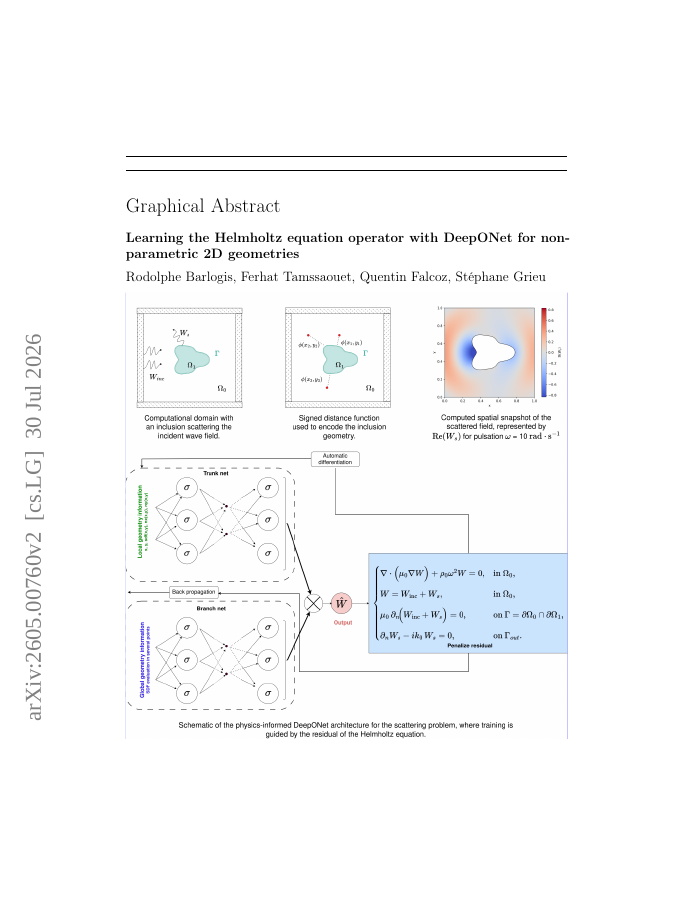
This paper deals with solving the 2D Helmholtz equation on non-parametric domains, leveraging a physics-informed neural operator network, the DeepONet framework. We consider a 2D square domain with an inclusion of arbitrary boundary geometry at its center. It acts as a scatterer for an incoming harmonic wave. The aim is to learn the operator linking the geometry of the scatterer to the resulting scattered field. A signed distance function to the boundary of the inner inclusion evaluated in several points on the domain is used to encode its geometry. It serves as input for the branch part of the DeepONet architecture and local information as the input for the trunk part. This approach enables the encoding of arbitrary geometries, whether they are parameterized or not. The evaluation of the model on unseen geometries was compared to its finite element method (FEM) equivalent to test its generalization capabilities. The trained network weights implicitly embed the local physics and their interaction with the domain geometry. If the training space sufficiently covers the target evaluation space, the model can generalize accordingly. Furthermore, it can be refined to extend to another region of interest without retraining from scratch. This framework also avoids the need to remesh the domain for each geometry. The proposed approach delivers a computationally lighter surrogate model than FEM alternatives and avoids relying on FEM generated training data.
Learning the Helmholtz equation operator with DeepONet for non-parametric 2D geometries
This paper deals with solving the 2D Helmholtz equation on non-parametric domains, leveraging a physics-informed neural operator network, the DeepONet framework. We consider a 2D square domain with an inclusion of arbitrary boundary geometry at its center.
- Preview
- Year
- 2026
- Hosting
- Excerpt onlyCC-BY-NC-4.0
Cite
Notes
Only stored in your browser.
Attribution
- Abstract & full text
- arxiv.org/abs/2605.00760CC-BY-NC-4.0
- TL;DR
- Semantic Scholar