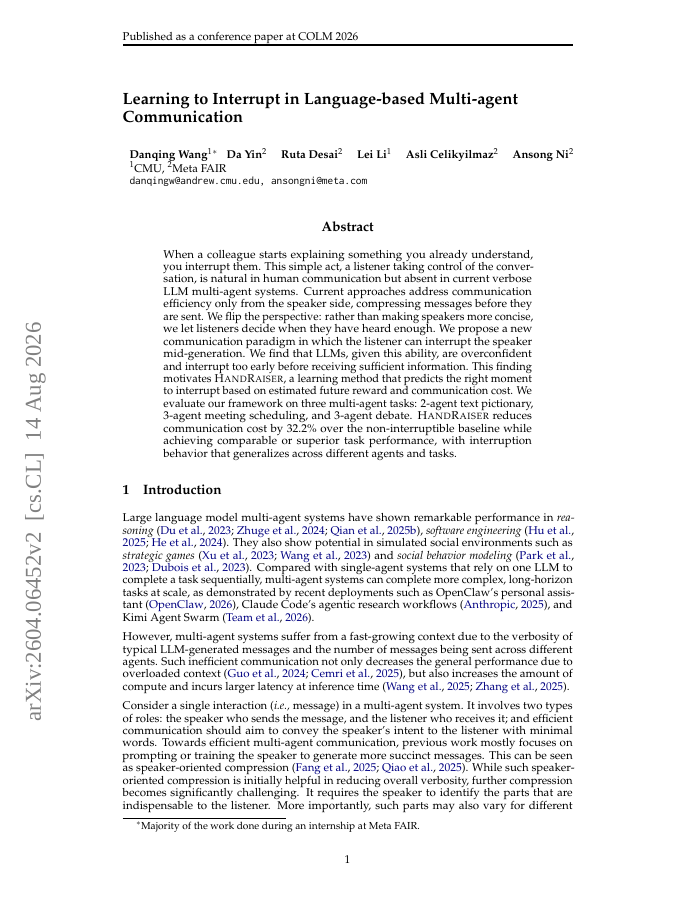
When a colleague starts explaining something you already understand, you interrupt them. This simple act, a listener taking control of the conversation, is natural in human communication but absent in current verbose LLM multi-agent systems. Current approaches address communication efficiency only from the speaker side, compressing messages before they are sent. We flip the perspective: rather than making speakers more concise, we let listeners decide when they have heard enough. We propose a new communication paradigm in which the listener can interrupt the speaker mid-generation. We find that LLMs, given this ability, are overconfident and interrupt too early before receiving sufficient information. This finding motivates HANDRAISER, a learning method that predicts the right moment to interrupt based on estimated future reward and communication cost. We evaluate our framework on three multi-agent tasks: 2-agent text pictionary, 3-agent meeting scheduling, and 3-agent debate. HANDRAISER reduces communication cost by 32.2% over the non-interruptible baseline while achieving comparable or superior task performance, with interruption behavior that generalizes across different agents and tasks.
Learning to Interrupt in Language-based Multi-agent Communication
When a colleague starts explaining something you already understand, you interrupt them. This simple act, a listener taking control of the conversation, is natural in human communication but absent in current verbose LLM multi-agent systems.
- Preview
- Year
- 2026
- Hosting
- Full text hostedCC-BY-4.0
Cite
Notes
Only stored in your browser.
Attribution
- Abstract & full text
- arxiv.org/abs/2604.06452CC-BY-4.0
- TL;DR
- Semantic Scholar