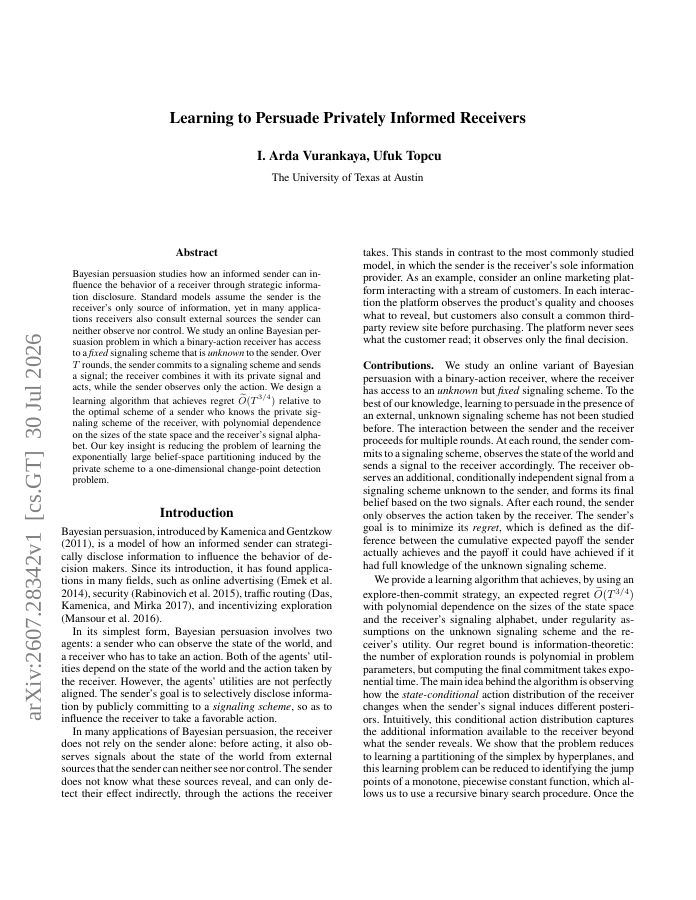
Bayesian persuasion studies how an informed sender can influence the behavior of a receiver through strategic information disclosure. Standard models assume the sender is the receiver's only source of information, yet in many applications receivers also consult external sources the sender can neither observe nor control. We study an online Bayesian persuasion problem in which a binary-action receiver has access to a fixed signaling scheme that is unknown to the sender. Over T rounds, the sender commits to a signaling scheme and sends a signal; the receiver combines it with its private signal and acts, while the sender observes only the action. We design a learning algorithm that achieves regret \widetilde{O}(T^{3/4}) relative to the optimal scheme of a sender who knows the private signaling scheme of the receiver, with polynomial dependence on the sizes of the state space and the receiver's signal alphabet. Our key insight is reducing the problem of learning the exponentially large belief-space partitioning induced by the private scheme to a one-dimensional change-point detection problem.
Learning to Persuade Privately Informed Receivers
Bayesian persuasion studies how an informed sender can influence the behavior of a receiver through strategic information disclosure. Standard models assume the sender is the receiver's only source of information, yet in many applications receivers also consult external sources…
- Preview
- Year
- 2026
- Hosting
- Abstract onlyARXIV-DEFAULT
Cite
Notes
Only stored in your browser.
Attribution
- Abstract & full text
- arxiv.org/abs/2607.28342ARXIV-DEFAULT
- TL;DR
- Semantic Scholar