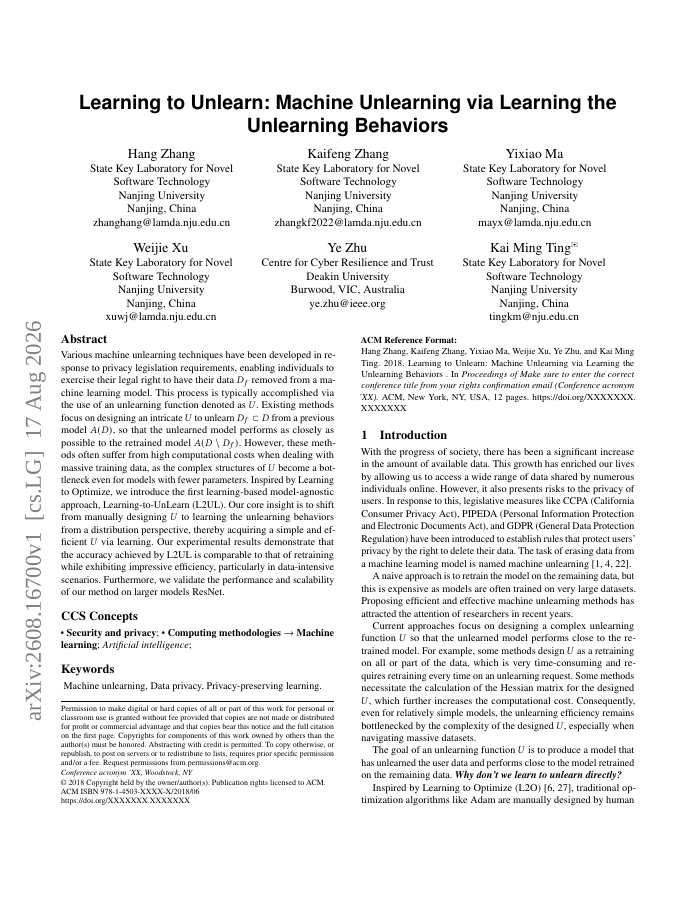
Various machine unlearning techniques have been developed in response to privacy legislation requirements, enabling individuals to exercise their legal right to have their data D_f removed from a machine learning model. This process is typically accomplished via the use of an unlearning function denoted as U. Existing methods focus on designing an intricate U to unlearn D_f \subset D from a previous model A(D), so that the unlearned model performs as closely as possible to the retrained model A(D \setminus D_f). However, these methods often suffer from high computational costs when dealing with massive training data, as the complex structures of U become a bottleneck even for models with fewer parameters. Inspired by Learning to Optimize, we introduce the first learning-based model-agnostic approach, Learning-to-UnLearn (L2UL). Our core insight is to shift from manually designing U to learning the unlearning behaviors from a distribution perspective, thereby acquiring a simple and efficient U via learning. Our experimental results demonstrate that the accuracy achieved by L2UL is comparable to that of retraining while exhibiting impressive efficiency, particularly in data-intensive scenarios. Furthermore, we validate the performance and scalability of our method on larger models ResNet.
Learning to Unlearn: Machine Unlearning via Learning the Unlearning Behaviors
Various machine unlearning techniques have been developed in response to privacy legislation requirements, enabling individuals to exercise their legal right to have their data $D_f$ removed from a machine learning model.
- Preview
- Year
- 2026
- Hosting
- Full text hostedCC-BY-4.0
Cite
Notes
Only stored in your browser.
Attribution
- Abstract & full text
- arxiv.org/abs/2608.16700CC-BY-4.0
- TL;DR
- Semantic Scholar