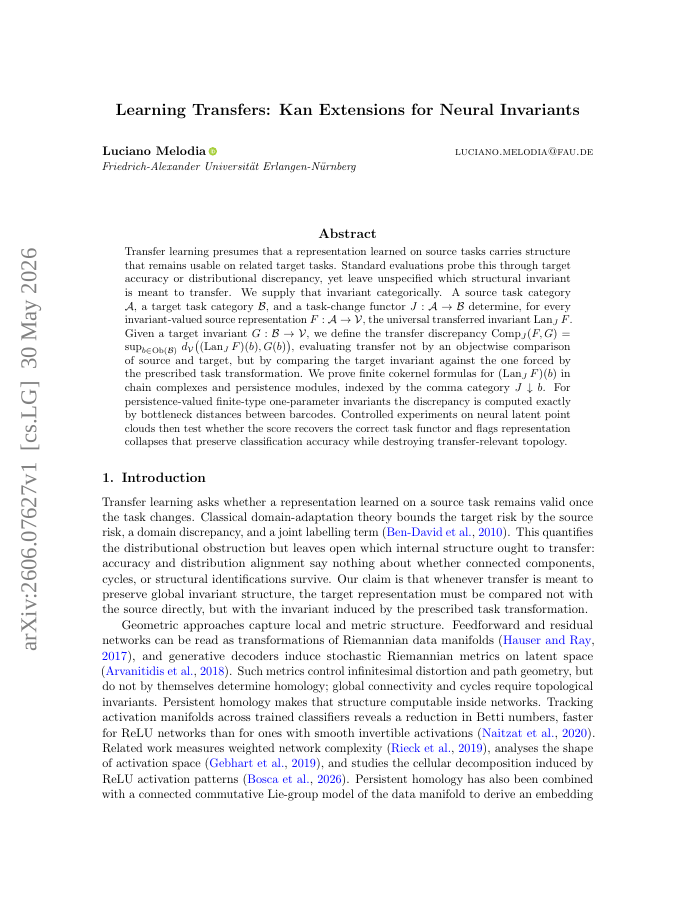
Transfer learning presumes that a representation learned on a source task carries structure that remains usable on a related target task. Standard evaluations probe this through target accuracy or a distributional discrepancy, without stating which structural invariant should survive the change of task. We make that invariant explicit and computable. We model a task as a small category: its objects are the task's components, such as data domains or class labels, and its morphisms are the admissible relations between them, such as the comparison of a coarse class with a fine class refining it. A change of task is a functor J:\mathcal A\to\mathcal B from the source task category to the target task category, recording where each component is sent and which are thereby identified. A trained representation is summarised by a functor F:A\toV into a category of invariants, e.g. the persistent homology of its latent point cloud per component. The target must then exhibit the left Kan extension \operatorname{Lan}JF, the universal extension of F along J. For an observed target invariant G:\mathcal B\to\mathcal V we define the transfer discrepancy \operatorname{Comp}J(F,G)=\sup{b\in\operatorname{Ob}(\mathcal B)}d{\mathcal V}((\operatorname{Lan}_JF)(b),G(b)), scoring transfer against the invariant J forces, not the source itself. We prove finite cokernel formulas for (\operatorname{Lan}_JF)(b) over the comma category J\downarrow b, in chain complexes and persistence modules, and for finite-type one-parameter persistence it equals the bottleneck distance between barcodes exactly. Controlled experiments on neural latent point clouds test whether the score recovers the correct change of task and flags representation collapses that preserve accuracy while destroying transfer-relevant topology.
Learning Transfers: Kan Extensions for Neural Invariants
Transfer learning presumes that a representation learned on a source task carries structure that remains usable on a related target task. Standard evaluations probe this through target accuracy or a distributional discrepancy, without stating which structural invariant should…
- Preview
- Year
- 2026
- Hosting
- Abstract onlyARXIV-DEFAULT
Cite
Notes
Only stored in your browser.
Attribution
- Abstract & full text
- arxiv.org/abs/2606.07627ARXIV-DEFAULT
- TL;DR
- Semantic Scholar