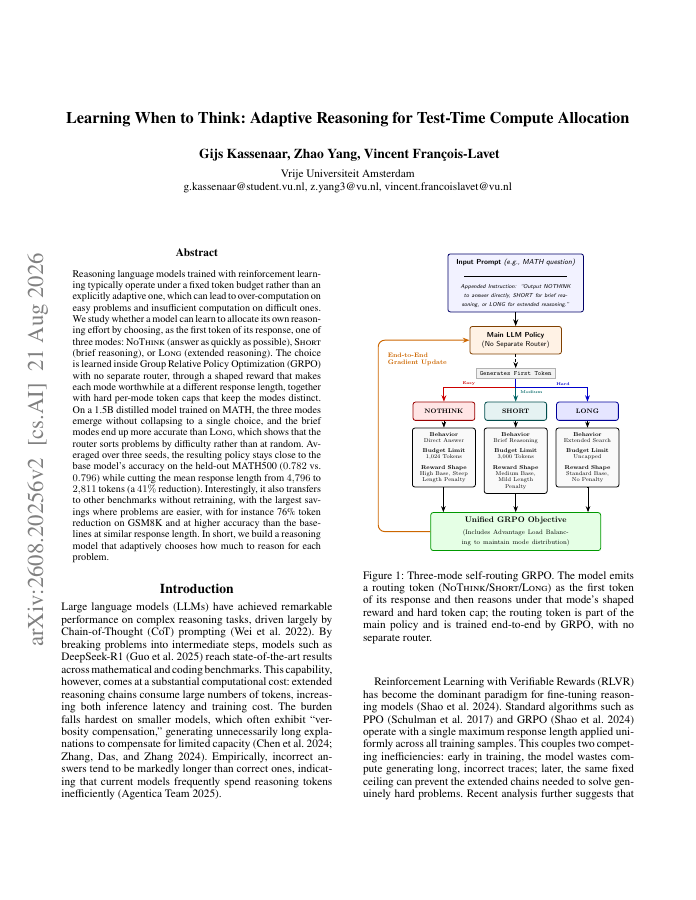
Reasoning language models trained with reinforcement learning typically operate under a fixed token budget rather than an explicitly adaptive one, which can lead to over-computation on easy problems and insufficient computation on difficult ones. We study whether a model can learn to allocate its own reasoning effort by choosing, as the first token of its response, one of three modes: NoThink (answer as quickly as possible), Short (brief reasoning), or Long (extended reasoning). The choice is learned inside Group Relative Policy Optimization (GRPO) with no separate router, through a shaped reward that makes each mode worthwhile at a different response length, together with hard per-mode token caps that keep the modes distinct. On a 1.5B distilled model trained on MATH, the three modes emerge without collapsing to a single choice, and the brief modes end up more accurate than Long, which shows that the router sorts problems by difficulty rather than at random. Averaged over three seeds, the resulting policy stays close to the base model's accuracy on the held-out MATH500 (0.782 vs.\ 0.796) while cutting the mean response length from 4{,}796 to 2{,}811 tokens (a 41% reduction). Interestingly, it also transfers to other benchmarks without retraining, with the largest savings where problems are easier, with for instance 76% token reduction on GSM8K and at higher accuracy than the baselines at similar response length. In short, we build a reasoning model that adaptively chooses how much to reason for each problem.
Learning When to Think: Adaptive Reasoning for Test-Time Compute Allocation
Reasoning language models trained with reinforcement learning typically operate under a fixed token budget rather than an explicitly adaptive one, which can lead to over-computation on easy problems and insufficient computation on difficult ones.
- Preview
- Year
- 2026
- Hosting
- Full text hostedCC-BY-4.0
Cite
Notes
Only stored in your browser.
Attribution
- Abstract & full text
- arxiv.org/abs/2608.20256CC-BY-4.0
- TL;DR
- Semantic Scholar