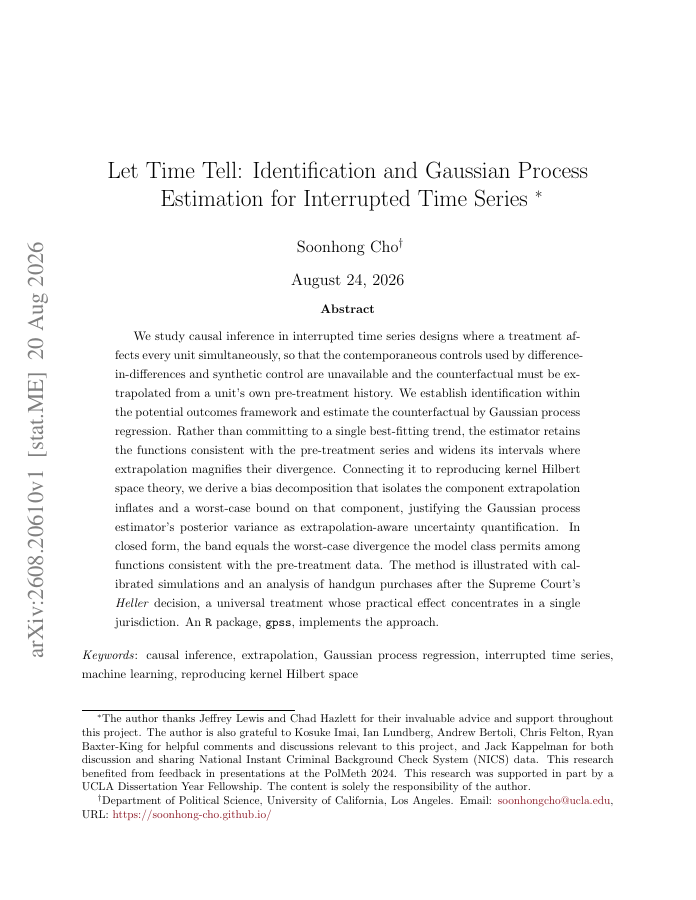
We study causal inference in interrupted time series designs where a treatment affects every unit simultaneously, so that the contemporaneous controls used by difference-in-differences and synthetic control are unavailable and the counterfactual must be extrapolated from a unit's own pre-treatment history. We establish identification within the potential outcomes framework and estimate the counterfactual by Gaussian process regression. Rather than committing to a single best-fitting trend, the estimator retains the functions consistent with the pre-treatment series and widens its intervals where extrapolation magnifies their divergence. Connecting it to reproducing kernel Hilbert space theory, we derive a bias decomposition that isolates the component extrapolation inflates and a worst-case bound on that component, justifying the Gaussian process estimator's posterior variance as extrapolation-aware uncertainty quantification. In closed form, the band equals the worst-case divergence the model class permits among functions consistent with the pre-treatment data. The method is illustrated with calibrated simulations and an analysis of handgun purchases after the Supreme Court's Heller decision, a universal treatment whose practical effect concentrates in a single jurisdiction. An R package, gpss, implements the approach.
Let Time Tell: Identification and Gaussian Process Estimation for Interrupted Time Series
We study causal inference in interrupted time series designs where a treatment affects every unit simultaneously, so that the contemporaneous controls used by difference-in-differences and synthetic control are unavailable and the counterfactual must be extrapolated from a…
- Preview
- Year
- 2026
- Hosting
- Abstract onlyARXIV-DEFAULT
Cite
Notes
Only stored in your browser.
Attribution
- Abstract & full text
- arxiv.org/abs/2608.20610ARXIV-DEFAULT
- TL;DR
- Semantic Scholar