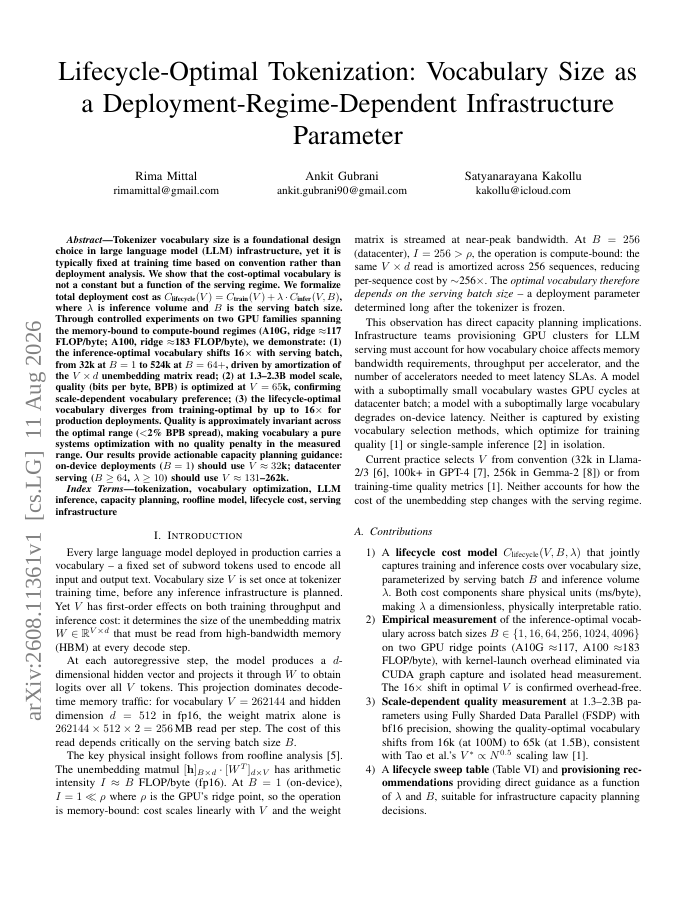
Tokenizer vocabulary size is a foundational design choice in large language model (LLM) infrastructure, yet it is typically fixed at training time based on convention rather than deployment analysis. We show that the cost-optimal vocabulary is not a constant but a function of the serving regime. We formalize total deployment cost as C_{lifecycle}(V) = C_{train}(V) + λ\cdot C_{infer}(V, B), where λ is inference volume and B is the serving batch size. Through controlled experiments on two GPU families spanning the memory-bound to compute-bound regimes (A10G, ridge \approx 117 FLOP/byte; A100, ridge \approx 183 FLOP/byte), we demonstrate: (1) the inference-optimal vocabulary shifts 16x with serving batch, from 32k at B=1 to 524k at B=64+, driven by amortization of the V \times d unembedding matrix read; (2) at 1.3-2.3B model scale, quality (bits per byte, BPB) is optimized at V=65k, confirming scale-dependent vocabulary preference; (3) the lifecycle-optimal vocabulary diverges from training-optimal by up to 16x for production deployments. Quality is approximately invariant across the optimal range (<2% BPB spread), making vocabulary a pure systems optimization with no quality penalty in the measured range. Our results provide actionable capacity planning guidance: on-device deployments (B=1) should use V \approx 32k; datacenter serving (B \geq 64, λ\geq 10) should use V \approx 131-262k.
Lifecycle-Optimal Tokenization: Vocabulary Size as a Deployment-Regime-Dependent Infrastructure Parameter
Tokenizer vocabulary size is a foundational design choice in large language model (LLM) infrastructure, yet it is typically fixed at training time based on convention rather than deployment analysis.
- Preview
- Year
- 2026
- Hosting
- Abstract onlyARXIV-DEFAULT
Cite
Notes
Only stored in your browser.
Attribution
- Abstract & full text
- arxiv.org/abs/2608.11361ARXIV-DEFAULT
- TL;DR
- Semantic Scholar