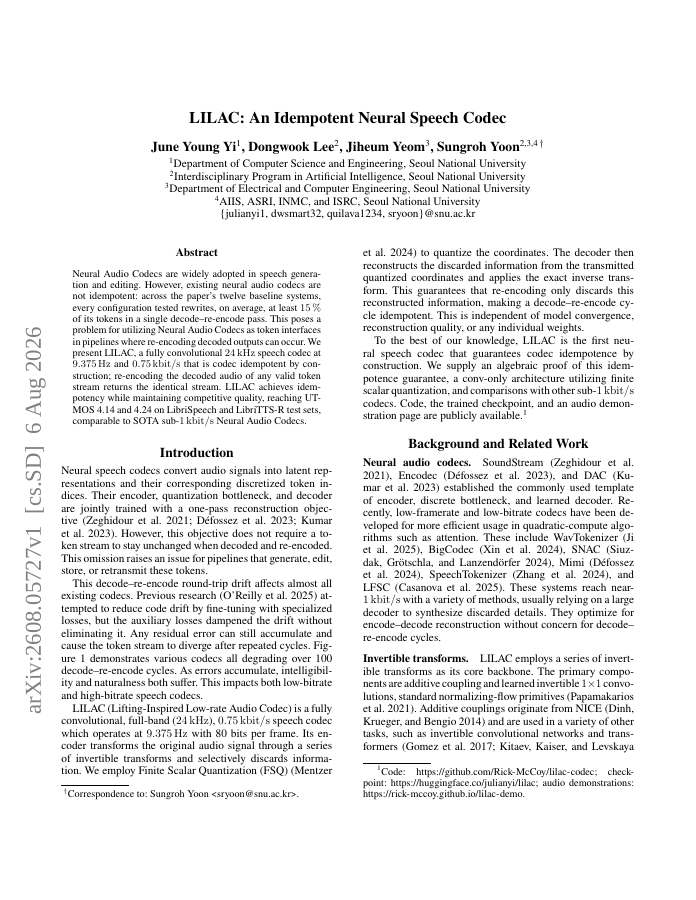
Neural Audio Codecs are widely adopted in speech generation and editing. However, existing neural audio codecs are not idempotent: across the paper's twelve baseline systems, every configuration tested rewrites, on average, at least 15% of its tokens in a single decode-re-encode pass. This poses a problem for utilizing Neural Audio Codecs as token interfaces in pipelines where re-encoding decoded outputs can occur. We present LILAC, a fully convolutional 24 kHz speech codec at 9.375 Hz and 0.75 kbit/s that is codec idempotent by construction; re-encoding the decoded audio of any valid token stream returns the identical stream. LILAC achieves idempotency while maintaining competitive quality, reaching UTMOS 4.14 and 4.24 on LibriSpeech and LibriTTS-R test sets, comparable to SOTA sub-1 kbit/s Neural Audio Codecs.
LILAC: An Idempotent Neural Speech Codec
Neural Audio Codecs are widely adopted in speech generation and editing. However, existing neural audio codecs are not idempotent: across the paper's twelve baseline systems, every configuration tested rewrites, on average, at least 15% of its tokens in a single decode-re-encode…
- Preview
- Year
- 2026
- Hosting
- Abstract onlyARXIV-DEFAULT
Cite
Notes
Only stored in your browser.
Attribution
- Abstract & full text
- arxiv.org/abs/2608.05727ARXIV-DEFAULT
- TL;DR
- Semantic Scholar