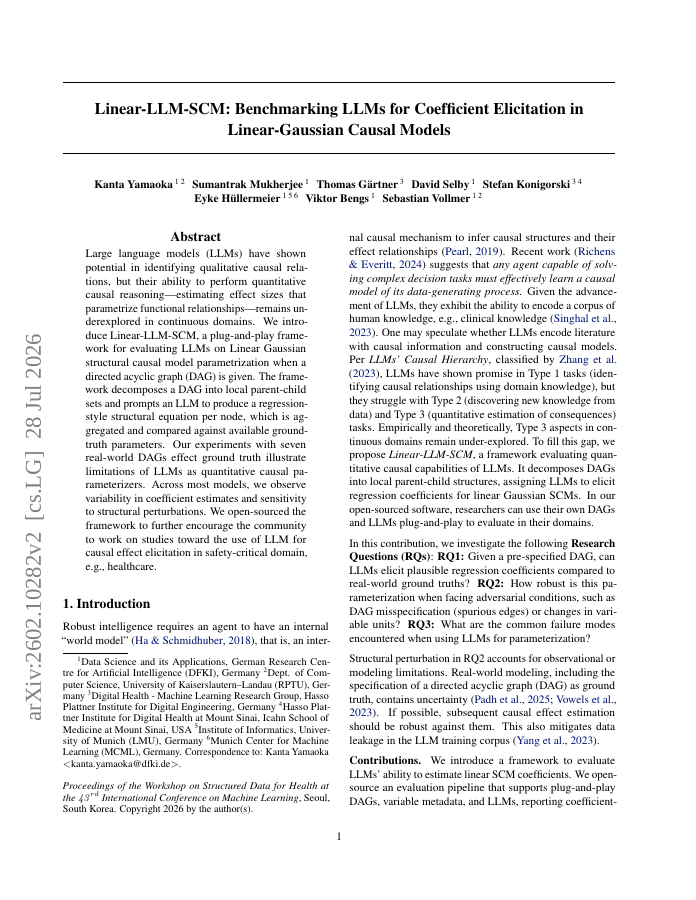
Large language models (LLMs) have shown potential in identifying qualitative causal relations, but their ability to perform quantitative causal reasoning---estimating effect sizes that parametrize functional relationships---remains underexplored in continuous domains. We introduce Linear-LLM-SCM, a plug-and-play framework for evaluating LLMs on Linear Gaussian structural causal model parametrization when a directed acyclic graph (DAG) is given. The framework decomposes a DAG into local parent-child sets and prompts an LLM to produce a regression-style structural equation per node, which is aggregated and compared against available ground-truth parameters. Our experiments with seven real-world DAGs effect ground truth illustrate limitations of LLMs as quantitative causal parameterizers. Across most models, we observe variability in coefficient estimates and sensitivity to structural perturbations. We open-sourced the framework to further encourage the community to work on studies toward the use of LLM for causal effect elicitation in safety-critical domain, e.g., healthcare.
Linear-LLM-SCM: Benchmarking LLMs for Coefficient Elicitation in Linear-Gaussian Causal Models
Large language models (LLMs) have shown potential in identifying qualitative causal relations, but their ability to perform quantitative causal reasoning---estimating effect sizes that parametrize functional relationships---remains underexplored in continuous domains.
- Preview
- Year
- 2026
- Hosting
- Full text hostedCC-BY-4.0
Cite
Notes
Only stored in your browser.
Attribution
- Abstract & full text
- arxiv.org/abs/2602.10282CC-BY-4.0
- TL;DR
- Semantic Scholar