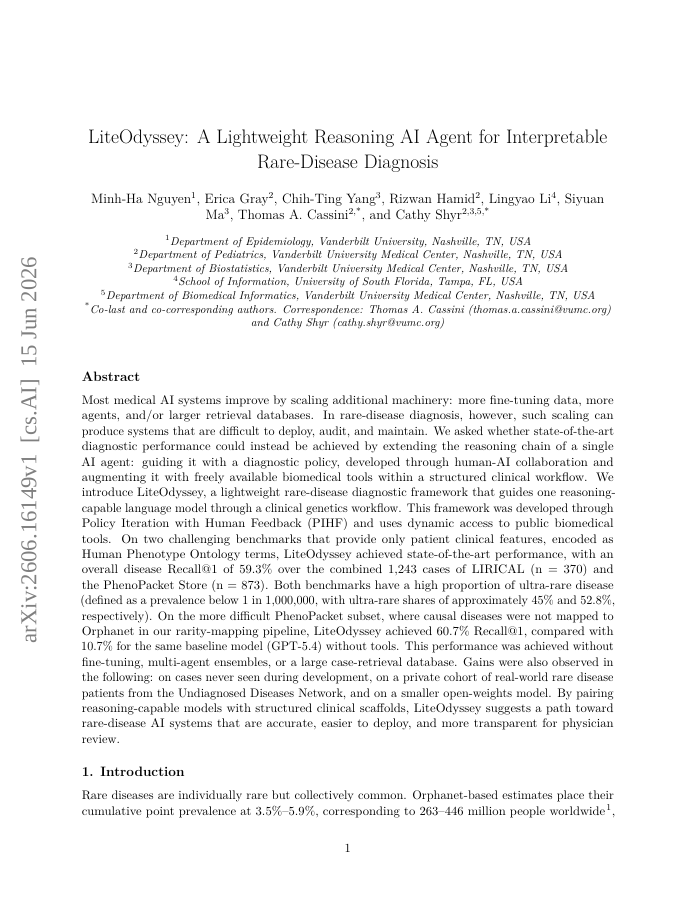
Rare disease diagnosis involves interpreting clinical and genetic findings through complex diagnostic reasoning. We investigated whether this reasoning could be translated into a portable policy for guiding general-purpose large language models (LLMs) without modifying model weights or requiring resource-intensive infrastructure. We developed liteOdyssey, a lightweight framework built through Policy Iteration with Human Feedback (PIHF), in which clinicians review the model's reasoning process to iteratively update the policy. This policy guides evidence gathering, tool use, and differential diagnosis generation with an auditable reasoning process. In an external evaluation of 515 Undiagnosed Diseases Network patients, liteOdyssey improved diagnostic accuracy over general-purpose LLMs. These results suggest a strategy for medical AI in which expert reasoning is operationalized as an auditable, reusable policy layer that guides unmodified LLMs without resource-intensive infrastructure.
LiteOdyssey: A Lightweight Reasoning AI Agent for Interpretable Rare-Disease Diagnosis
Rare disease diagnosis involves interpreting clinical and genetic findings through complex diagnostic reasoning. We investigated whether this reasoning could be translated into a portable policy for guiding general-purpose large language models (LLMs) without modifying model…
- Preview
- Year
- 2026
- Hosting
- Full text hostedCC-BY-4.0
Cite
Notes
Only stored in your browser.
Attribution
- Abstract & full text
- arxiv.org/abs/2606.16149CC-BY-4.0
- TL;DR
- Semantic Scholar