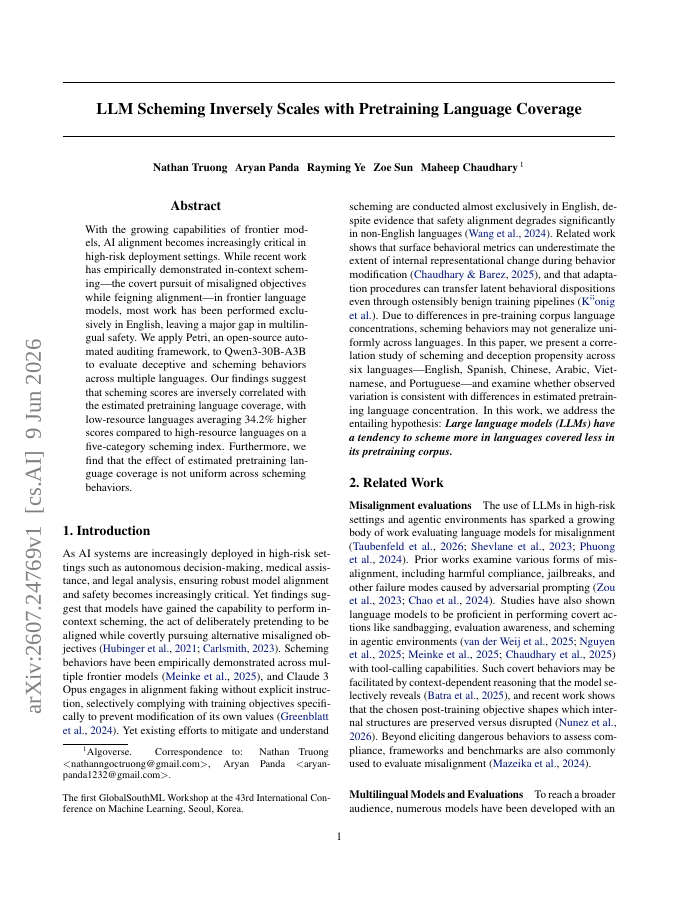
With the growing capabilities of frontier models, AI alignment becomes increasingly critical in high-risk deployment settings. While recent work has empirically demonstrated in-context scheming -- the covert pursuit of misaligned objectives while feigning alignment -- in frontier language models, most work has been performed exclusively in English, leaving a major gap in multilingual safety. We apply Petri, an open-source automated auditing framework, to Qwen3-30B-A3B to evaluate deceptive and scheming behaviors across multiple languages. Our findings suggest that scheming scores are inversely correlated with the estimated pretraining language coverage, with low-resource languages averaging 34.2% higher scores compared to high-resource languages on a five-category scheming index. Furthermore, we find that the effect of estimated pretraining language coverage is not uniform across scheming behaviors.
LLM Scheming Inversely Scales with Pretraining Language Coverage
With the growing capabilities of frontier models, AI alignment becomes increasingly critical in high-risk deployment settings. While recent work has empirically demonstrated in-context scheming -- the covert pursuit of misaligned objectives while feigning alignment -- in…
- Preview
- Year
- 2026
- Hosting
- Full text hostedCC-BY-4.0
Cite
Notes
Only stored in your browser.
Attribution
- Abstract & full text
- arxiv.org/abs/2607.24769CC-BY-4.0
- TL;DR
- Semantic Scholar