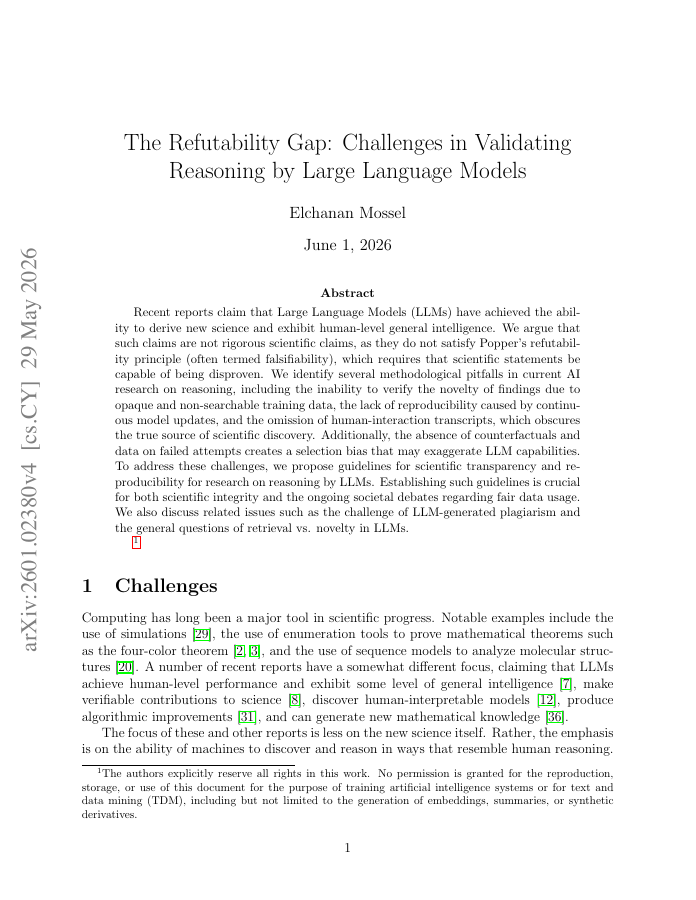
Recent reports claim that Large Language Models (LLMs) derive new science and exhibit human-level general intelligence. Such claims are entangled with two different narratives about what LLMs do: one in which they are an engine of synthesis that genuinely reasons to new knowledge, and one in which they retrieve and re-emit the work of others without attribution. In the scientific setting these are best understood as a contrast between reasoning and plagiarism. Finding where the truth lies between these two narratives is very challenging, as central components of the model -- the training data and the interaction transcript -- remain opaque. Thus claims of LLM reasoning do not satisfy Popper's refutability principle. We propose guidelines for transparency and reproducibility that will allow reasoning claims to be studied using the scientific method. The dominance of the reasoning narrative, we suggest, is in practice encouraging plagiarism in the scientific literature; we discuss what might be done about it.
LLMs, Reasoning and Plagiarism
Recent reports claim that Large Language Models (LLMs) derive new science and exhibit human-level general intelligence. Such claims are entangled with two different narratives about what LLMs do: one in which they are an engine of synthesis that genuinely reasons to new…
- Preview
- Year
- 2026
- Hosting
- Abstract onlyARXIV-DEFAULT
Cite
Notes
Only stored in your browser.
Attribution
- Abstract & full text
- arxiv.org/abs/2601.02380ARXIV-DEFAULT
- TL;DR
- Semantic Scholar