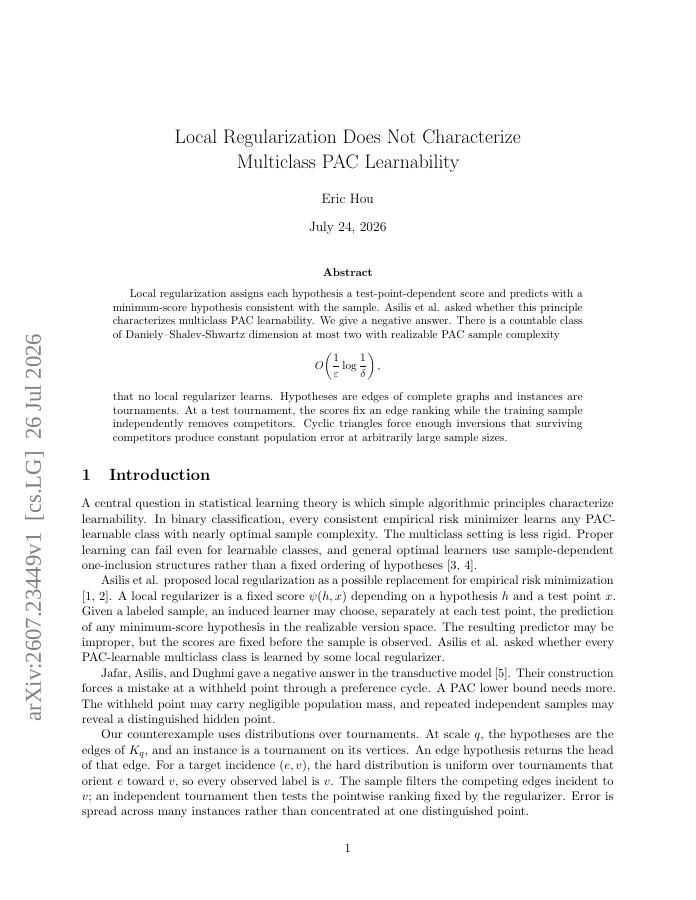
Local regularization assigns each hypothesis a test-point-dependent score and predicts with a minimum-score hypothesis consistent with the sample. Asilis et al. asked whether this principle characterizes multiclass PAC learnability. We give a negative answer. There is a countable class of Daniely--Shalev-Shwartz dimension at most two with realizable PAC sample complexity [ O!\left(\frac{1}{\varepsilon}\log\frac{1}δ\right), ] that no local regularizer learns. Hypotheses are edges of complete graphs and instances are tournaments. At a test tournament, the scores fix an edge ranking while the training sample independently removes competitors. Cyclic triangles force enough inversions that surviving competitors produce constant population error at arbitrarily large sample sizes.
Local Regularization Does Not Characterize Multiclass PAC Learnability
Local regularization assigns each hypothesis a test-point-dependent score and predicts with a minimum-score hypothesis consistent with the sample. Asilis et al. asked whether this principle characterizes multiclass PAC learnability. We give a negative answer.
- Preview
- Year
- 2026
- Hosting
- Full text hostedCC-BY-4.0
Cite
Notes
Only stored in your browser.
Attribution
- Abstract & full text
- arxiv.org/abs/2607.23449CC-BY-4.0
- TL;DR
- Semantic Scholar