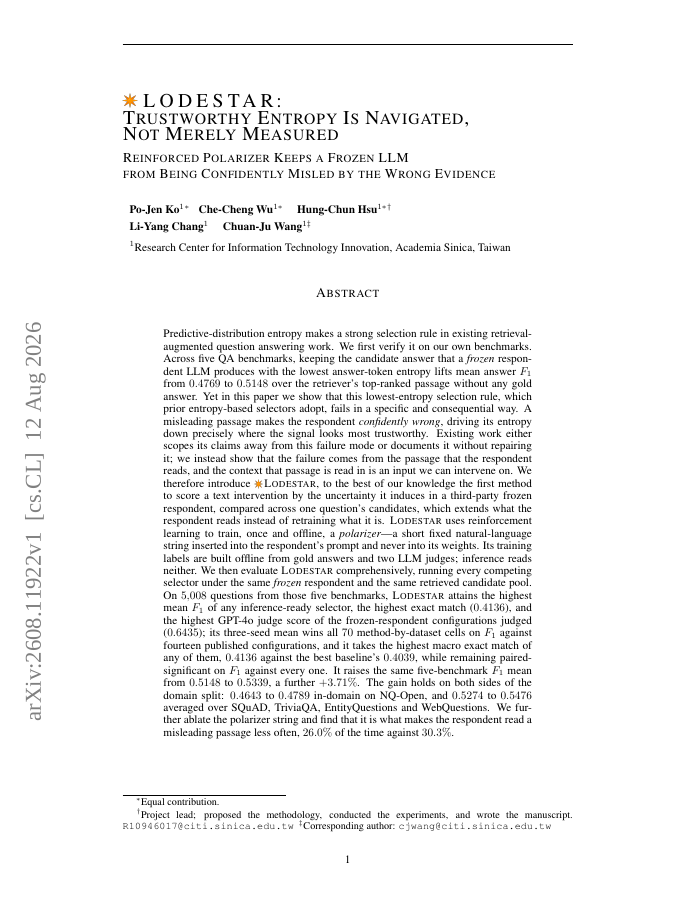
Predictive-distribution entropy is a strong answer-selection rule in retrieval-augmented generation (RAG) for question answering: across five QA benchmarks, selecting the answer a frozen respondent LLM produces with the lowest answer-token entropy lifts mean F_1 from 0.4769 to 0.5148 over the retriever's top-ranked passage, without gold answers. Yet this rule, which prior entropy-based selectors adopt, fails: a misleading passage makes the respondent confidently wrong, driving entropy down where the uncertainty signal looks most trustworthy. The failure comes from the passage the respondent reads, and the context it is read in is an input we can intervene on. We introduce LODESTAR: to our knowledge the first method to score a text intervention by the uncertainty it induces in a third-party frozen respondent, compared within one question. LODESTAR uses reinforcement learning (GRPO) to train, once and offline, a polarizer -- a short fixed natural-language string inserted into the respondent's prompt and never into its weights, directing entropy so that entropy-based answer selection stays robust to misleading passages; training labels are built from gold answers and two LLM judges, and inference reads neither. With every competing selector under the same frozen respondent and candidate pools on 5,008 questions, LODESTAR attains the highest mean F_1 of any inference-ready selector (0.5339), the highest macro exact match (0.4136), and the highest GPT-4o judge score of the frozen-respondent configurations judged (0.6435); its three-seed mean wins all 70 F_1 cells against fourteen published configurations and is paired-significant on F_1 against every one. The gain holds in-domain on NQ-Open and out-of-domain over SQuAD, TriviaQA, EntityQuestions and WebQuestions. Ablating the polarizer shows it is what makes the respondent read a misleading passage less often (26.0% vs 30.3%).
LODESTAR: Robust Entropy-Based Answer Selection in Retrieval-Augmented Generation for Question Answering -- Directing Frozen-LLM Entropy with a Reinforcement-Learned Prompt Polarizer under Misleading Passages
Predictive-distribution entropy is a strong answer-selection rule in retrieval-augmented generation (RAG) for question answering: across five QA benchmarks, selecting the answer a frozen respondent LLM produces with the lowest answer-token entropy lifts mean $F_1$ from 0.4769 to…
- Preview
- Year
- 2026
- Hosting
- Abstract onlyARXIV-DEFAULT
Cite
Notes
Only stored in your browser.
Attribution
- Abstract & full text
- arxiv.org/abs/2608.11922ARXIV-DEFAULT
- TL;DR
- Semantic Scholar