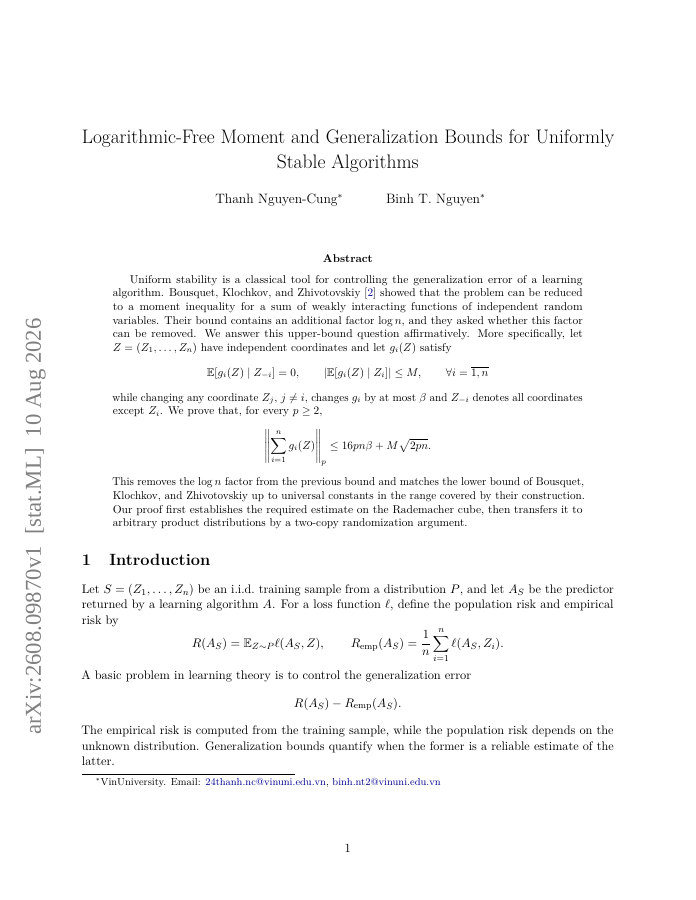
Uniform stability is a classical tool for controlling the generalization error of a learning algorithm. Bousquet, Klochkov, and Zhivotovskiy (2020) showed that the problem can be reduced to a moment inequality for a sum of weakly interacting functions of independent random variables. Their bound contains an additional factor \log n, and they asked whether this factor can be removed. We answer this upper-bound question affirmatively. More specifically, let Z=(Z_1,\ldots,Z_n) have independent coordinates and let g_i(Z) satisfy $ \mathbb E[g_i(Z)\mid Z_{-i}]=0, \qquad \left| \mathbb E[g_i(Z)\mid Z_i]\right|\le M, \qquad \forall i = \overline{1, n} while changing any coordinate Z_j, j\neq i, changes g_i by at most β and Z_{-i} denotes all coordinates except Z_i. We prove that, for every p\ge2, \left| \sum_{i=1}^n g_i(Z)\right|_p \le 16pnβ+M\sqrt{2pn}. This removes the \log n$ factor from the previous bound and matches the lower bound of Bousquet, Klochkov, and Zhivotovskiy up to universal constants in the range covered by their construction. Our proof first establishes the required estimate on the Rademacher cube, then transfers it to arbitrary product distributions by a two-copy randomization argument.
Logarithmic-Free Moment and Generalization Bounds for Uniformly Stable Algorithms
Uniform stability is a classical tool for controlling the generalization error of a learning algorithm. Bousquet, Klochkov, and Zhivotovskiy (2020) showed that the problem can be reduced to a moment inequality for a sum of weakly interacting functions of independent random…
- Preview
- Year
- 2026
- Hosting
- Full text hostedCC-BY-4.0
Cite
Notes
Only stored in your browser.
Attribution
- Abstract & full text
- arxiv.org/abs/2608.09870CC-BY-4.0
- TL;DR
- Semantic Scholar