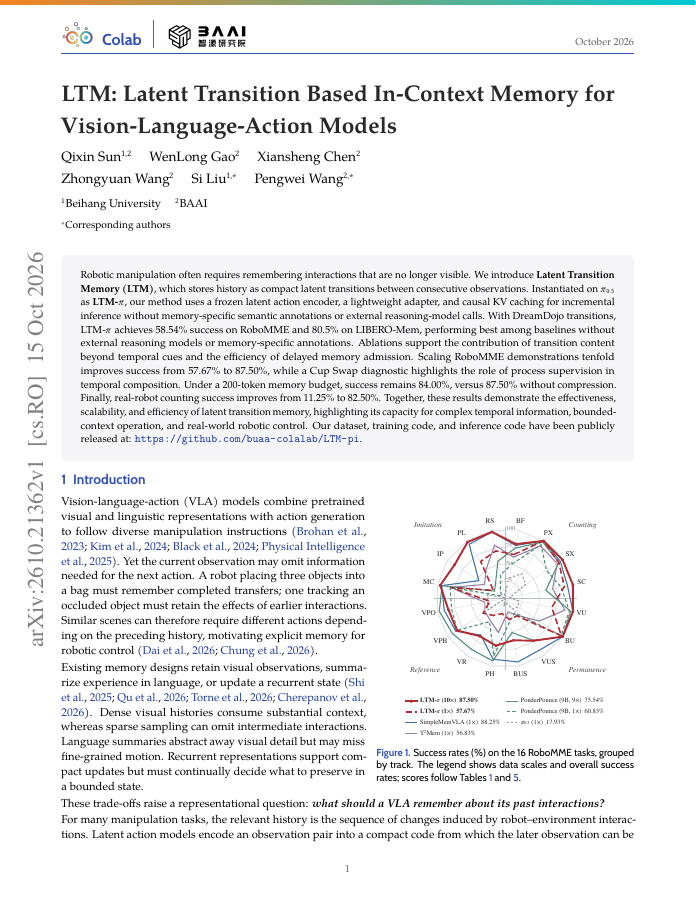
Robotic manipulation often requires remembering interactions that are no longer visible. We introduce Latent Transition Memory (LTM), which stores history as compact latent transitions between consecutive observations. Instantiated on π_{0.5} as LTM-π, our method uses a frozen latent action encoder, a lightweight adapter, and causal KV caching for incremental inference without memory-specific semantic annotations or external reasoning-model calls. With DreamDojo transitions, LTM-π achieves 58.54% success on RoboMME and 80.5% on LIBERO-Mem, performing best among baselines without external reasoning models or memory-specific annotations. Ablations support the contribution of transition content beyond temporal cues and the efficiency of delayed memory admission. Scaling RoboMME demonstrations tenfold improves success from 57.67% to 87.50%, while a Cup Swap diagnostic highlights the role of process supervision in temporal composition. Under a 200-token memory budget, success remains 84.00%, versus 87.50% without compression. Finally, real-robot counting success improves from 11.25% to 82.50%. Together, these results demonstrate the effectiveness, scalability, and efficiency of latent transition memory, highlighting its capacity for complex temporal information, bounded-context operation, and real-world robotic control.
LTM: Latent Transition Based In-Context Memory for Vision-Language-Action Models
Robotic manipulation often requires remembering interactions that are no longer visible. We introduce Latent Transition Memory (LTM), which stores history as compact latent transitions between consecutive observations.
- Preview
- Year
- 2026
- Stars
- 6
- Hosting
- Full text hostedCC-BY-4.0
Cite
Notes
Only stored in your browser.
Attribution
- Abstract & full text
- arxiv.org/abs/2610.21362CC-BY-4.0
- TL;DR
- Semantic Scholar