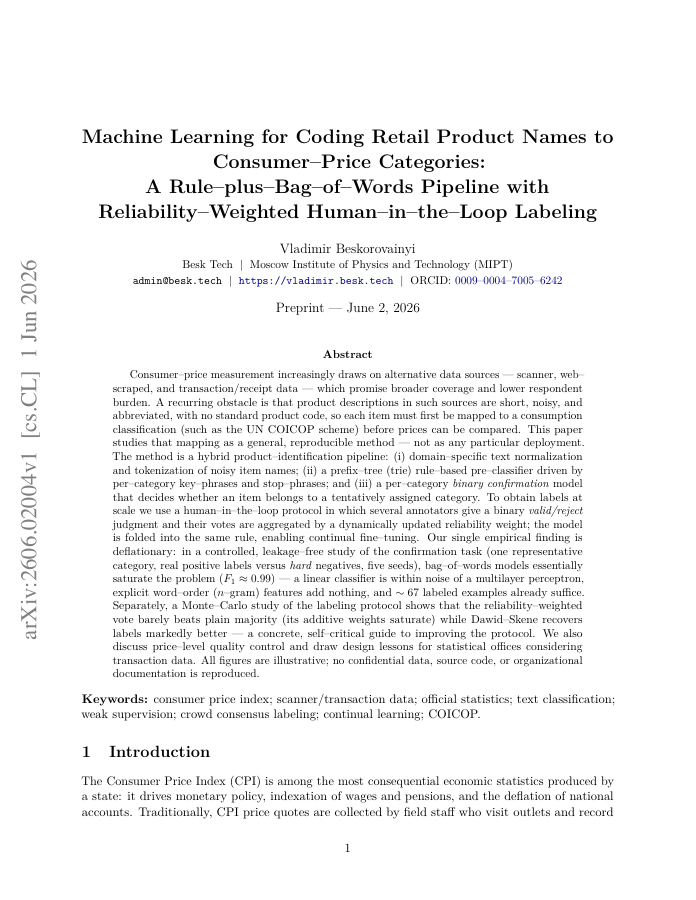
Consumer-price measurement increasingly draws on alternative data sources -- scanner, web-scraped, and transaction/receipt data -- whose product descriptions are short, noisy, and carry no standard product code, so each item must first be mapped to a consumption classification (e.g., the UN COICOP scheme) before prices can be compared. This paper studies that mapping as a general, reproducible method. The pipeline is: (i) text normalization and tokenization of noisy item names; (ii) a prefix-tree (trie) rule-based pre-classifier driven by per-category key-phrases and stop-phrases; and (iii) a per-category binary confirmation model. For labels at scale we use a human-in-the-loop protocol in which annotators give a binary valid/reject judgment aggregated by a dynamically updated reliability weight; the model joins the same rule, enabling continual fine-tuning. On a reproducible synthetic benchmark of six COICOP-like categories, under one matched protocol, cheap models win and order-sensitive ones do not help: a character n-gram logistic regression tops every category (mean F1 = 0.997), word-order features add nothing, and small CNN/LSTM models are the weakest in this small-data regime. The trie alone admits only 32-50% of items, so the learned stage is necessary, and about 66 labels per category suffice. A Monte-Carlo study of the labeling protocol is self-critical: the reliability-weighted vote barely beats plain majority while Dawid-Skene recovers labels markedly better. No proprietary or production data are used; all code and synthetic data are released at https://doi.org/10.5281/zenodo.20909563
Machine Learning for Coding Retail Product Names to Consumer-Price Categories: A Rule-plus-Bag-of-Words Pipeline with Reliability-Weighted Human-in-the-Loop Labeling
Consumer-price measurement increasingly draws on alternative data sources -- scanner, web-scraped, and transaction/receipt data -- whose product descriptions are short, noisy, and carry no standard product code, so each item must first be mapped to a consumption classification…
- Preview
- Year
- 2026
- Hosting
- Abstract onlyARXIV-DEFAULT
Cite
Notes
Only stored in your browser.
Attribution
- Abstract & full text
- arxiv.org/abs/2606.02004ARXIV-DEFAULT
- TL;DR
- Semantic Scholar