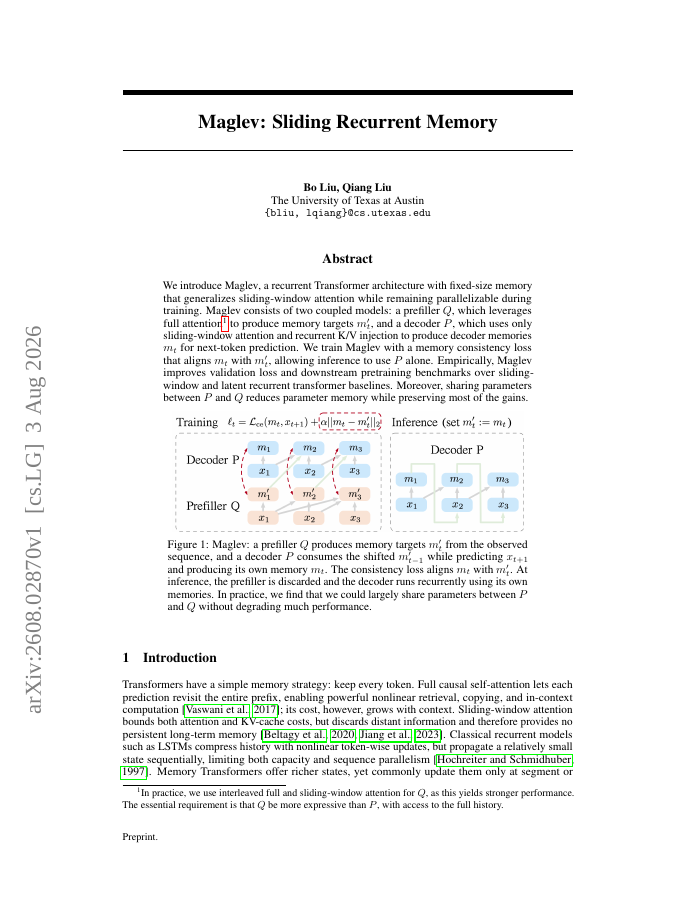
We introduce \ours{}, a recurrent Transformer architecture with fixed-size memory that generalizes sliding-window attention while remaining parallelizable during training. \ours{} consists of two coupled models: a prefiller Q, which leverages full attention\footnote{In practice, we use interleaved full and sliding-window attention for Q, as this yields stronger performance. The essential requirement is that Q be more expressive than P, with access to the full history.} to produce memory targets m'_t, and a decoder P, which uses only sliding-window attention and recurrent K/V injection to produce decoder memories m_t for next-token prediction. We train \ours{} with a memory consistency loss that aligns m_t with m'_t, allowing inference to use P alone. Empirically, \ours{} improves validation loss and downstream pretraining benchmarks over sliding-window and latent recurrent transformer baselines. Moreover, sharing parameters between P and Q reduces parameter memory while preserving most of the gains.
Maglev: Sliding Recurrent Memory
We introduce \ours{}, a recurrent Transformer architecture with fixed-size memory that generalizes sliding-window attention while remaining parallelizable during training.
- Preview
- Year
- 2026
- Hosting
- Full text hostedCC-BY-4.0
Cite
Notes
Only stored in your browser.
Attribution
- Abstract & full text
- arxiv.org/abs/2608.02870CC-BY-4.0
- TL;DR
- Semantic Scholar