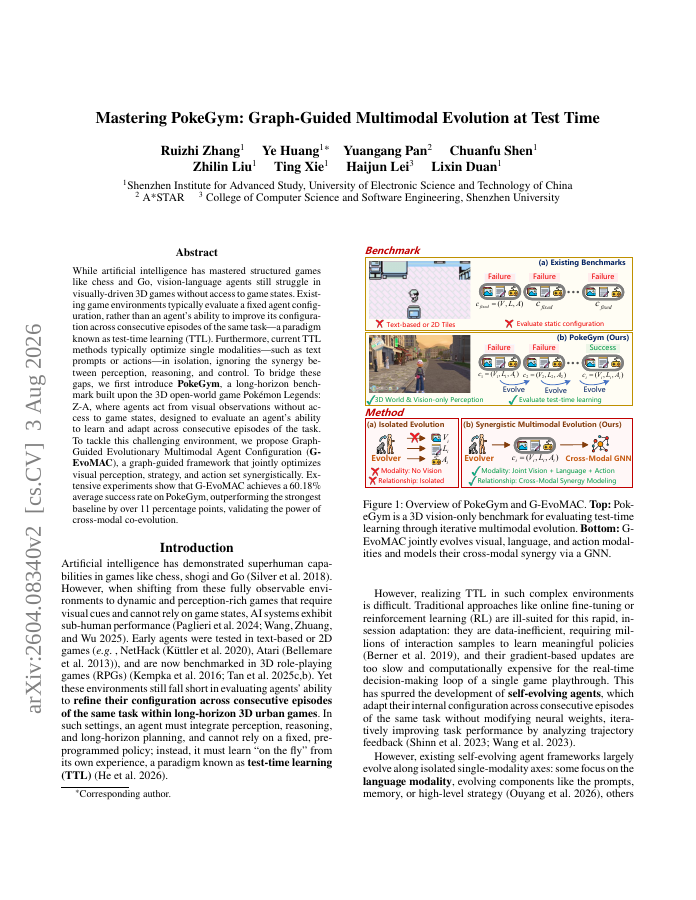
While artificial intelligence has mastered structured games like chess and Go, vision-language agents still struggle in visually-driven 3D games without access to game states. Existing game environments typically evaluate a fixed agent configuration, rather than an agent's ability to improve its configuration across consecutive episodes of the same task---a paradigm known as test-time learning (TTL). Furthermore, current TTL methods typically optimize single modalities---such as text prompts or actions---in isolation, ignoring the synergy between perception, reasoning, and control. To bridge these gaps, we first introduce PokeGym, a long-horizon benchmark built upon the 3D open-world game Pokémon Legends: Z-A, where agents act from visual observations without access to game states, designed to evaluate an agent's ability to learn and adapt across consecutive episodes of the task. To tackle this challenging environment, we propose Graph-Guided Evolutionary Multimodal Agent Configuration (G-EvoMAC), a graph-guided framework that jointly optimizes visual perception, strategy, and action set synergistically. Extensive experiments show that G-EvoMAC achieves a 60.18% average success rate on PokeGym, outperforming the strongest baseline by over 11 percentage points, validating the power of cross-modal co-evolution.
Mastering PokeGym: Graph-Guided Multimodal Evolution at Test Time
While artificial intelligence has mastered structured games like chess and Go, vision-language agents still struggle in visually-driven 3D games without access to game states.
- Preview
- Year
- 2026
- Hosting
- Full text hostedCC-BY-4.0
Cite
Notes
Only stored in your browser.
Attribution
- Abstract & full text
- arxiv.org/abs/2604.08340CC-BY-4.0
- TL;DR
- Semantic Scholar