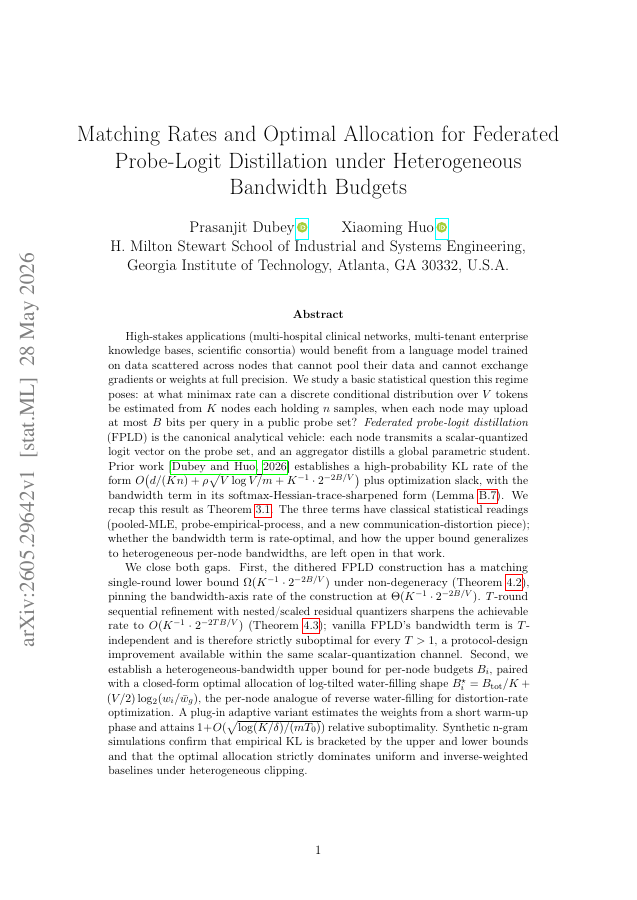
In federated language modeling, K nodes each hold n samples but cannot pool data or exchange full-precision gradients or weights. We study the minimax rate at which a conditional distribution over V tokens can be estimated when each node may upload at most B bits per query in a public probe set. In federated probe-logit distillation (FPLD), each node transmits a scalar-quantized logit vector on the probe set, and an aggregator distills a global parametric student. Prior work (Dubey and Huo, 2026) establishes a high-probability KL rate O(d/(Kn) + ρ\sqrt{V \log V / m} + K^{-1} \cdot 2^{-2B/V}) plus optimization slack, with the bandwidth term in its trace-sharpened form. Whether this bandwidth-term rate is tight, and how the upper bound generalizes to heterogeneous per-node bandwidths, are left open. We close both gaps. First, the dithered FPLD construction has a matching single-round lower bound Ω(K^{-1} \cdot 2^{-2B/V}) under non-degeneracy, pinning the bandwidth-axis rate at Θ(K^{-1} \cdot 2^{-2B/V}). T-round sequential refinement with nested/scaled residual quantizers achieves O(K^{-1} \cdot 2^{-2TB/V}); vanilla FPLD's T-independent bandwidth term is suboptimal for every T > 1. Second, we establish a heterogeneous-bandwidth upper bound for per-node budgets B_i, paired with a closed-form optimal allocation B_i^* = B_{tot}/K + (V/2) \log_2(w_i / \bar{w}_g), a log-tilted water-filling rule that is the per-node analogue of reverse water-filling for distortion-rate optimization. A plug-in adaptive variant estimates the weights from a short warm-up phase and attains 1 + O(\sqrt{\log(K/δ)/(m T_0)}) relative suboptimality. Synthetic n-gram simulations confirm that empirical KL is bracketed by the upper and lower bounds and that the optimal allocation strictly dominates uniform and inverse-weighted baselines under heterogeneous clipping.
Matching Rates and Optimal Allocation for Federated Probe-Logit Distillation under Heterogeneous Bandwidth Budgets
In federated language modeling, $K$ nodes each hold $n$ samples but cannot pool data or exchange full-precision gradients or weights. We study the minimax rate at which a conditional distribution over $V$ tokens can be estimated when each node may upload at most $B$ bits per…
- Preview
- Year
- 2026
- Hosting
- Abstract onlyARXIV-DEFAULT
Cite
Notes
Only stored in your browser.
Attribution
- Abstract & full text
- arxiv.org/abs/2605.29642ARXIV-DEFAULT
- TL;DR
- Semantic Scholar