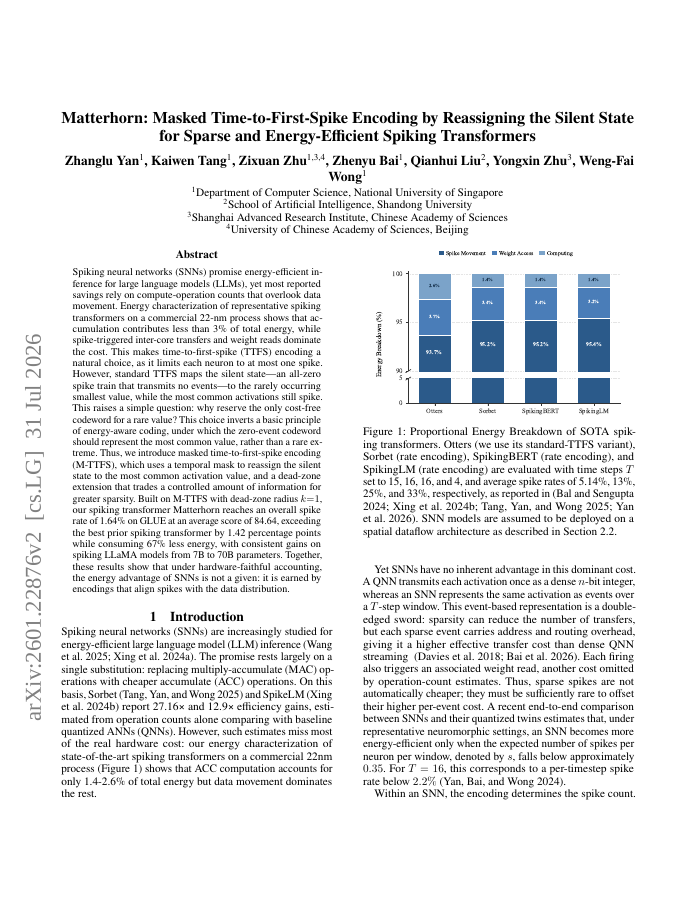
Spiking neural networks (SNNs) promise energy-efficient inference for large language models (LLMs), yet most reported savings rely on compute-operation counts that overlook data movement. Energy characterization of representative spiking transformers on a commercial 22-nm process shows that accumulation contributes less than 3% of total energy, while spike-triggered inter-core transfers and weight reads dominate the cost. This makes time-to-first-spike (TTFS) encoding a natural choice, as it limits each neuron to at most one spike. However, standard TTFS maps the silent state, an all-zero spike train that transmits no events, to the rarely occurring smallest value, while the most common activations still spike. This raises a simple question: why reserve the only cost-free codeword for a rare value? This choice inverts a basic principle of energy-aware coding, under which the zero-event codeword should represent the most common value, rather than a rare extreme. Thus, we introduce masked time-to-first-spike encoding (M-TTFS), which uses a temporal mask to reassign the silent state to the most common activation value, and a dead-zone extension that trades a controlled amount of information for greater sparsity. Built on M-TTFS with dead-zone radius k{=}1, our spiking transformer Matterhorn reaches an overall spike rate of 1.64% on GLUE at an average score of 84.64, exceeding the best prior spiking transformer by 1.42 percentage points while consuming 67% less energy, with consistent gains on spiking LLaMA models from 7B to 70B parameters. Together, these results show that under hardware-faithful accounting, the energy advantage of SNNs is not a given: it is earned by encodings that align spikes with the data distribution.
Matterhorn: Masked Time-to-First-Spike Encoding by Reassigning the Silent State for Sparse and Energy-Efficient Spiking Transformers
Spiking neural networks (SNNs) promise energy-efficient inference for large language models (LLMs), yet most reported savings rely on compute-operation counts that overlook data movement.
- Preview
- Year
- 2026
- Hosting
- Abstract onlyARXIV-DEFAULT
Cite
Notes
Only stored in your browser.
Attribution
- Abstract & full text
- arxiv.org/abs/2601.22876ARXIV-DEFAULT
- TL;DR
- Semantic Scholar