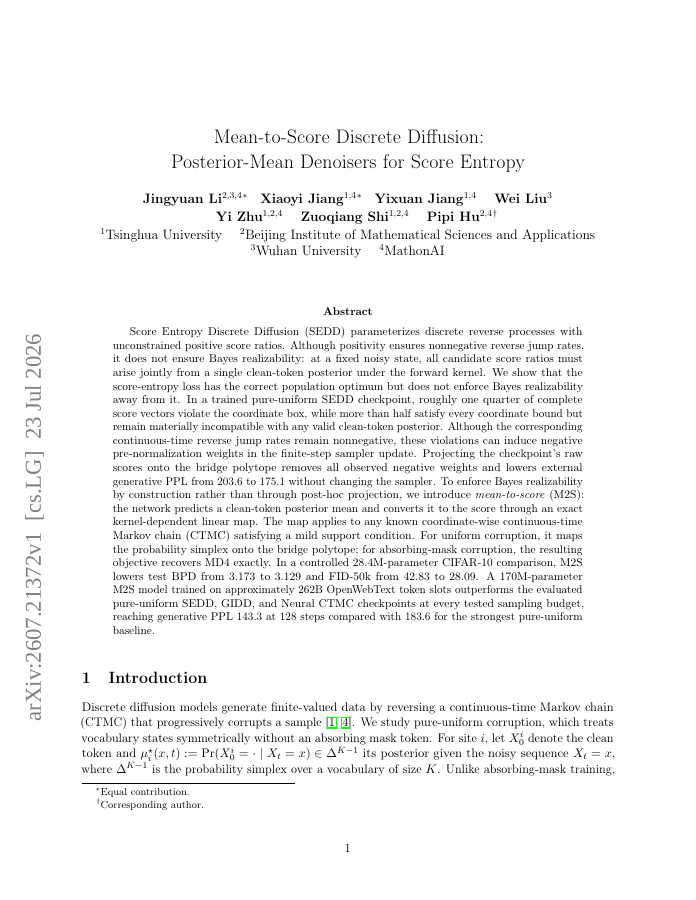
Score Entropy Discrete Diffusion (SEDD) parameterizes discrete reverse processes with unconstrained positive score ratios. While positivity guarantees nonnegative reverse jump rates, it does not ensure Bayes realizability: ratios at a noisy state need not be jointly induced by any clean-token posterior under the forward kernel. The score-entropy loss has the correct population optimum but does not enforce this constraint away from it. In a trained pure-uniform SEDD checkpoint, roughly one quarter of complete score vectors violate the coordinate box, while more than half lie inside it yet remain materially incompatible with any valid posterior. Such violations can produce negative pre-normalization weights in finite-step sampling. Projecting raw scores onto the bridge polytope removes all observed negative weights and improves external generative PPL from 203.6 to 175.1 without changing the sampler. We introduce mean-to-score (M2S), which predicts a clean-token posterior mean and converts it to the score through an exact kernel-dependent linear map. The construction applies to any known coordinate-wise continuous-time Markov chain (CTMC) satisfying a mild support condition. For uniform corruption, it maps the probability simplex onto the bridge polytope; for absorbing-mask corruption, the resulting objective recovers MD4 exactly. In a controlled 28.4M-parameter CIFAR-10 comparison, M2S lowers test BPD from 3.173 to 3.129 and FID-50k from \CifarSEDDFID to \CifarMtwoSFID. A 170M-parameter M2S model trained on about 262B OpenWebText token slots outperforms the evaluated pure-uniform SEDD, GIDD, and Neural CTMC checkpoints at every tested sampling budget, reaching generative PPL 143.3 at 128 steps versus 183.6 for the strongest pure-uniform baseline.
Mean-to-Score Discrete Diffusion: Posterior-Mean Denoisers for Score Entropy
Score Entropy Discrete Diffusion (SEDD) parameterizes discrete reverse processes with unconstrained positive score ratios. While positivity guarantees nonnegative reverse jump rates, it does not ensure Bayes realizability: ratios at a noisy state need not be jointly induced by…
- Preview
- Year
- 2026
- Hosting
- Full text hostedCC-BY-4.0
Cite
Notes
Only stored in your browser.
Attribution
- Abstract & full text
- arxiv.org/abs/2607.21372CC-BY-4.0
- TL;DR
- Semantic Scholar