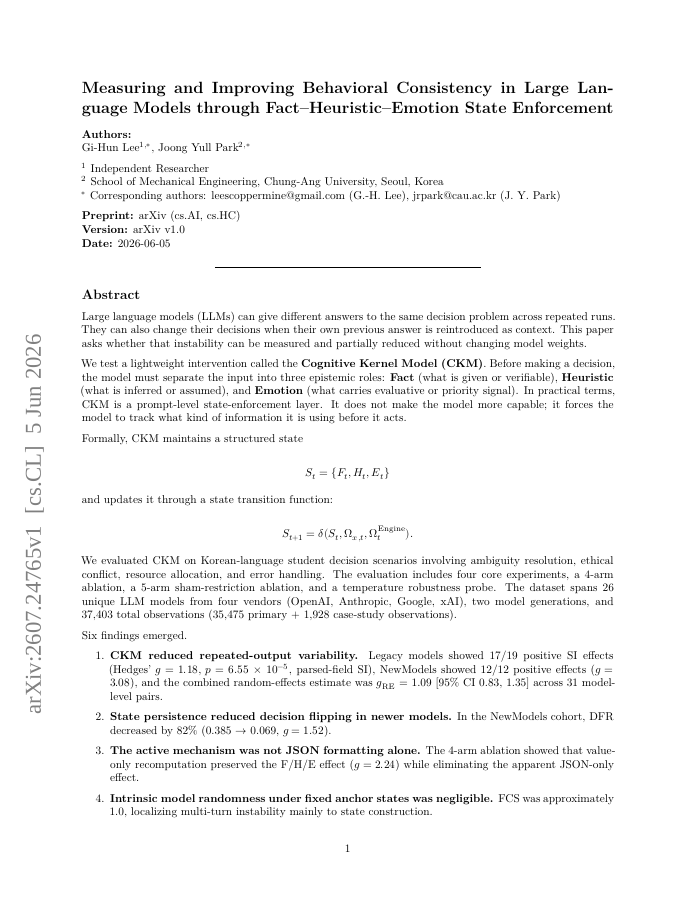
Large language models (LLMs) can give different answers to the same decision problem across runs, and reverse a decision when their own prior answer returns as context. We ask whether this instability can be measured and partially reduced without changing model weights. We test the Cognitive Kernel Model (CKM), a prompt-level state-enforcement layer. Before deciding, the model must separate its input into three epistemic roles: Fact (given or verifiable), Heuristic (inferred or assumed), and Emotion (evaluative or priority signal). CKM adds no capability; it forces the model to track what kind of information it uses before acting. Formally it maintains a structured state S_t = {F_t, H_t, E_t} updated by a transition function. We evaluate CKM on Korean-language decision scenarios (ambiguity, ethical conflict, resource allocation, error handling) across 26 LLMs from four vendors and 37,403 observations, via four core experiments, a 4-arm ablation, a 5-arm sham-restriction ablation, and a temperature probe. Findings: (1) CKM reduces repeated-output variability (random-effects Hedges' g=1.09, 95% CI [0.83, 1.35], 31 model pairs); (2) state persistence cuts the decision-flip rate by 82% in newer models (g=1.52); (3) the effect is not JSON formatting alone (value-only recomputation, g=2.24); (4) intrinsic randomness under fixed anchor states is negligible; (5) the advantage grows under sampling stochasticity (g=2.87 at temperature 0.7); (6) a sham ablation attributes about 45% of the gain to structural scaffolding and 55% to Fact/Heuristic/Emotion content, and CKM is the only arm that both raises consistency and reduces flipping. CKM does not improve reasoning correctness. The narrower result: behavioral consistency is measurable, varies across models, and is partially improvable by forcing models to separate facts, assumptions, and evaluative signals before deciding.
Measuring and Improving Behavioral Consistency in Large Language Models through Fact-Heuristic-Emotion State Enforcement
Large language models (LLMs) can give different answers to the same decision problem across runs, and reverse a decision when their own prior answer returns as context. We ask whether this instability can be measured and partially reduced without changing model weights.
- Preview
- Year
- 2026
- Hosting
- Abstract onlyARXIV-DEFAULT
Cite
Notes
Only stored in your browser.
Attribution
- Abstract & full text
- arxiv.org/abs/2607.24765ARXIV-DEFAULT
- TL;DR
- Semantic Scholar