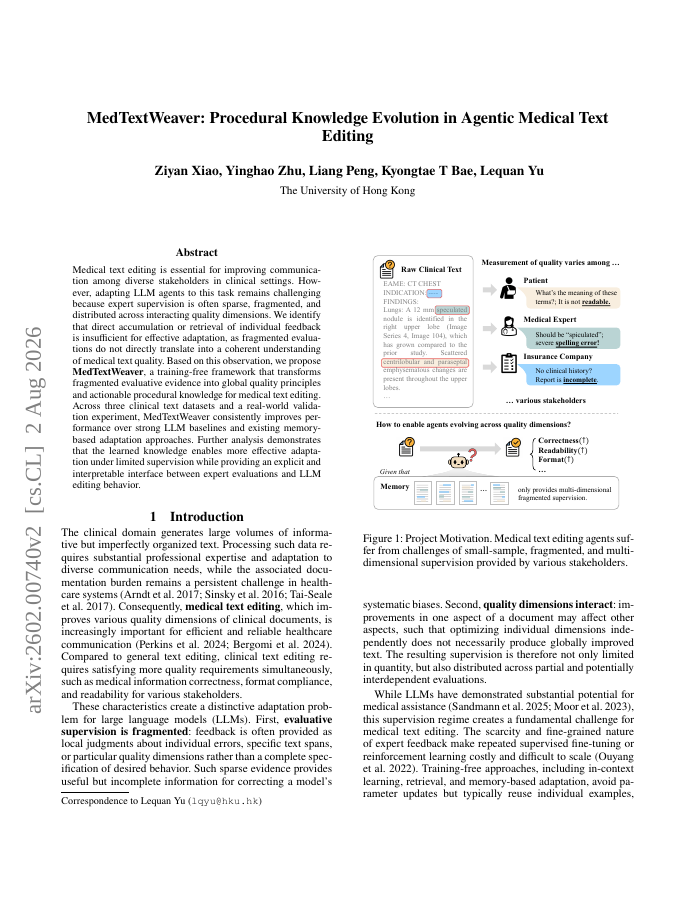
Medical text editing is essential for improving communication among diverse stakeholders in clinical settings. However, adapting LLM agents to this task remains challenging because expert supervision is often sparse, fragmented, and distributed across interacting quality dimensions. We identify that direct accumulation or retrieval of individual feedback is insufficient for effective adaptation, as fragmented evaluations do not directly translate into a coherent understanding of medical text quality. Based on this observation, we propose MedTextWeaver, a training-free framework that transforms fragmented evaluative evidence into global quality principles and actionable procedural knowledge for medical text editing. Across three clinical text datasets and a real-world validation experiment, MedTextWeaver consistently improves performance over strong LLM baselines and existing memory-based adaptation approaches. Further analysis demonstrates that the learned knowledge enables more effective adaptation under limited supervision while providing an explicit and interpretable interface between expert evaluations and LLM editing behavior.
MedTextWeaver: Procedural Knowledge Evolution in Agentic Medical Text Editing
Medical text editing is essential for improving communication among diverse stakeholders in clinical settings. However, adapting LLM agents to this task remains challenging because expert supervision is often sparse, fragmented, and distributed across interacting quality…
- Preview
- Year
- 2026
- Hosting
- Abstract onlyARXIV-DEFAULT
Cite
Notes
Only stored in your browser.
Attribution
- Abstract & full text
- arxiv.org/abs/2602.00740ARXIV-DEFAULT
- TL;DR
- Semantic Scholar