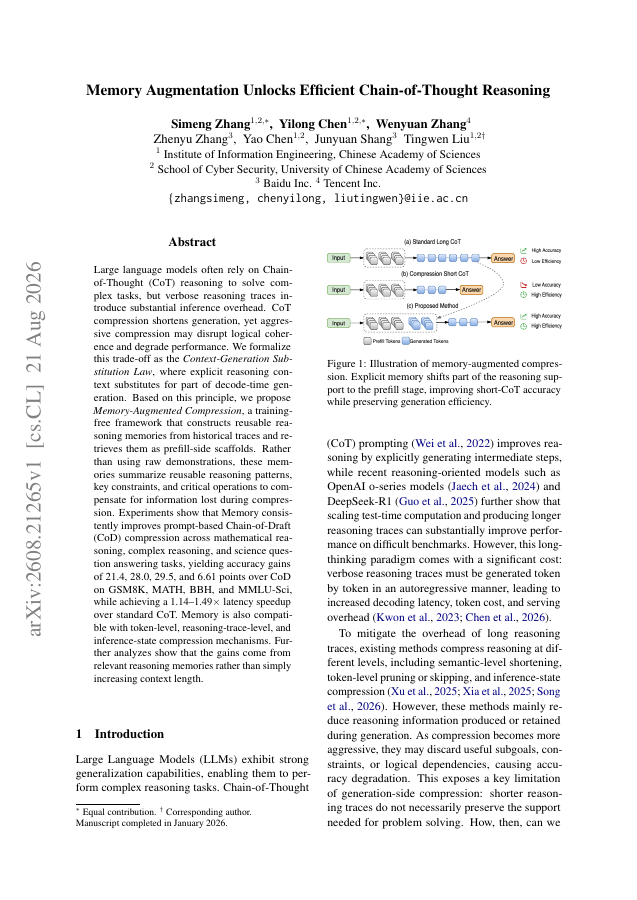
Large language models often rely on Chain-of-Thought (CoT) reasoning to solve complex tasks, but verbose reasoning traces introduce substantial inference overhead. CoT compression shortens generation, yet aggressive compression may disrupt logical coherence and degrade performance. We formalize this trade-off as the Context-Generation Substitution Law, where explicit reasoning context substitutes for part of decode-time generation. Based on this principle, we propose Memory-Augmented Compression, a training-free framework that constructs reusable reasoning memories from historical traces and retrieves them as prefill-side scaffolds. Rather than using raw demonstrations, these memories summarize reusable reasoning patterns, key constraints, and critical operations to compensate for information lost during compression. Experiments show that Memory consistently improves prompt-based Chain-of-Draft (CoD) compression across mathematical reasoning, complex reasoning, and science question answering tasks, yielding accuracy gains of 21.4, 28.0, 29.5, and 6.61 points over CoD on GSM8K, MATH, BBH, and MMLU-Sci, while achieving a 1.14--1.49\times latency speedup over standard CoT. Memory is also compatible with token-level, reasoning-trace-level, and inference-state compression mechanisms. Further analyzes show that the gains come from relevant reasoning memories rather than simply increasing context length.
Memory Augmentation Unlocks Efficient Chain-of-Thought Reasoning
Large language models often rely on Chain-of-Thought (CoT) reasoning to solve complex tasks, but verbose reasoning traces introduce substantial inference overhead. CoT compression shortens generation, yet aggressive compression may disrupt logical coherence and degrade…
- Preview
- Year
- 2026
- Hosting
- Abstract onlyARXIV-DEFAULT
Cite
Notes
Only stored in your browser.
Attribution
- Abstract & full text
- arxiv.org/abs/2608.21265ARXIV-DEFAULT
- TL;DR
- Semantic Scholar