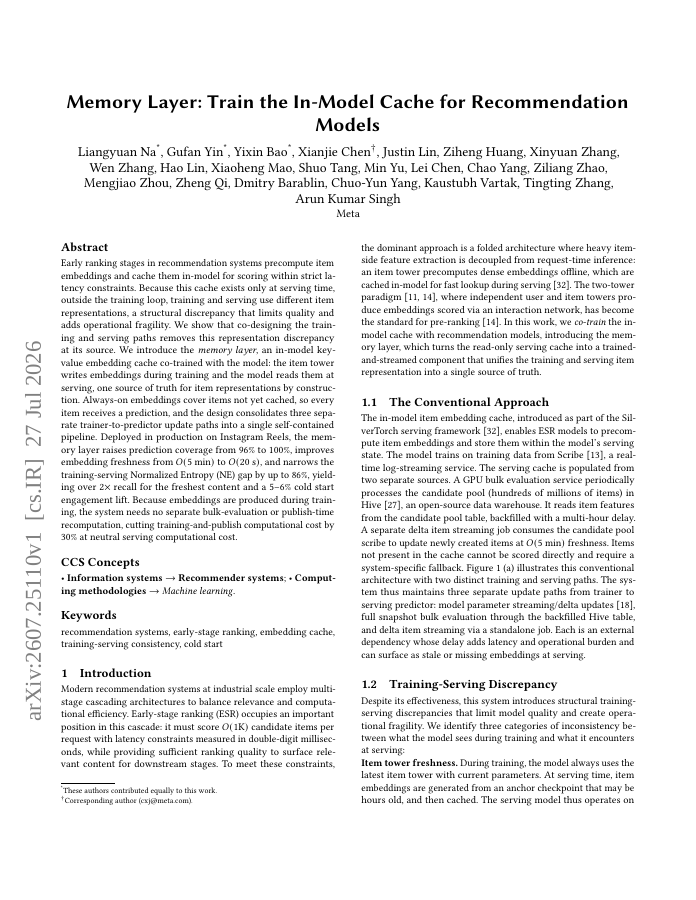
Early ranking stages in recommendation systems precompute item embeddings and cache them in-model for scoring within strict latency constraints. Because this cache exists only at serving time, outside the training loop, training and serving use different item representations, a structural discrepancy that limits quality and adds operational fragility. We show that co-designing the training and serving paths removes this representation discrepancy at its source. We introduce the memory layer, an in-model key-value embedding cache co-trained with the model: the item tower writes embeddings during training and the model reads them at serving, one source of truth for item representations by construction. Always-on embeddings cover items not yet cached, so every item receives a prediction, and the design consolidates three separate trainer-to-predictor update paths into a single self-contained pipeline. Deployed in production on Instagram Reels, the memory layer raises prediction coverage from 96% to 100%, improves embedding freshness from O(5 min) to O(20 s), and narrows the training-serving Normalized Entropy (NE) gap by up to 86%, yielding over 2\times recall for the freshest content and a 5-6% cold start engagement lift. Because embeddings are produced during training, the system needs no separate bulk-evaluation or publish-time recomputation, cutting training-and-publish computational cost by 30% at neutral serving computational cost.
Memory Layer: Train the In-Model Cache for Recommendation Models
Early ranking stages in recommendation systems precompute item embeddings and cache them in-model for scoring within strict latency constraints. Because this cache exists only at serving time, outside the training loop, training and serving use different item representations, a…
- Preview
- Year
- 2026
- Hosting
- Abstract onlyARXIV-DEFAULT
Cite
Notes
Only stored in your browser.
Attribution
- Abstract & full text
- arxiv.org/abs/2607.25110ARXIV-DEFAULT
- TL;DR
- Semantic Scholar