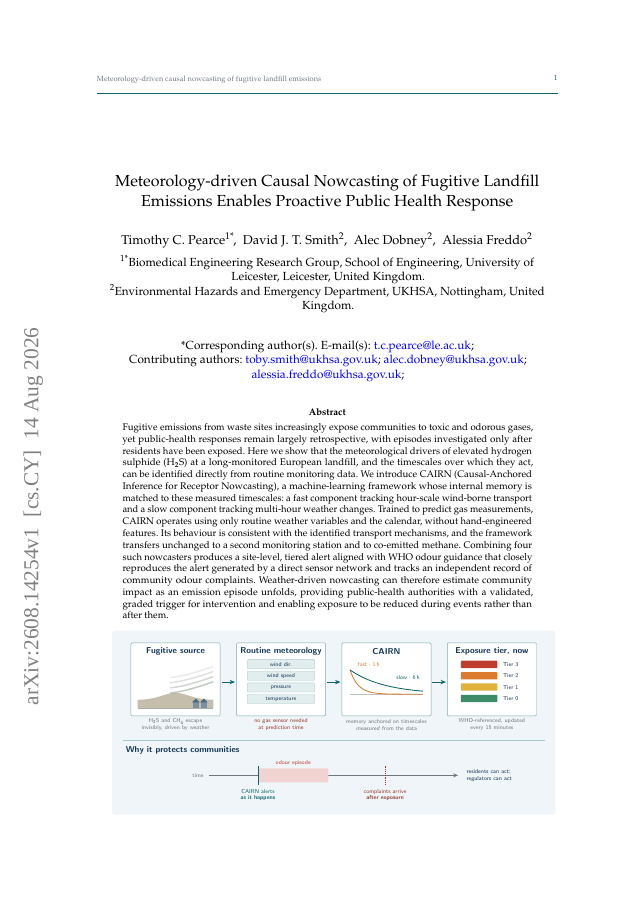
Fugitive emissions from waste sites increasingly expose communities to toxic and odorous gases, yet public-health responses remain largely retrospective, with episodes investigated only after residents have been exposed. Here we show that the meteorological drivers of elevated hydrogen sulphide (HS) at a long-monitored European landfill, and the timescales over which they act, can be identified directly from routine monitoring data. We introduce CAIRN (Causal-Anchored Inference for Receptor Nowcasting), a machine-learning framework whose internal memory is matched to these measured timescales: a fast component tracking hour-scale wind-borne transport and a slow component tracking multi-hour weather changes. Trained to predict gas measurements, CAIRN operates using only routine weather variables and the calendar, without hand-engineered features. Its behaviour is consistent with the identified transport mechanisms, and the framework transfers unchanged to a second monitoring station and to co-emitted methane. Combining four such nowcasters produces a site-level, tiered alert aligned with WHO odour guidance that closely reproduces the alert generated by a direct sensor network and tracks an independent record of community odour complaints. Weather-driven nowcasting can therefore estimate community impact as an emission episode unfolds, providing public-health authorities with a validated, graded trigger for intervention and enabling exposure to be reduced during events rather than after them.
Meteorology-driven Causal Nowcasting of Fugitive Landfill Emissions Enables Proactive Public Health Response
Fugitive emissions from waste sites increasingly expose communities to toxic and odorous gases, yet public-health responses remain largely retrospective, with episodes investigated only after residents have been exposed.
- Preview
- Year
- 2026
- Hosting
- Full text hostedCC-BY-4.0
Cite
Notes
Only stored in your browser.
Attribution
- Abstract & full text
- arxiv.org/abs/2608.14254CC-BY-4.0
- TL;DR
- Semantic Scholar