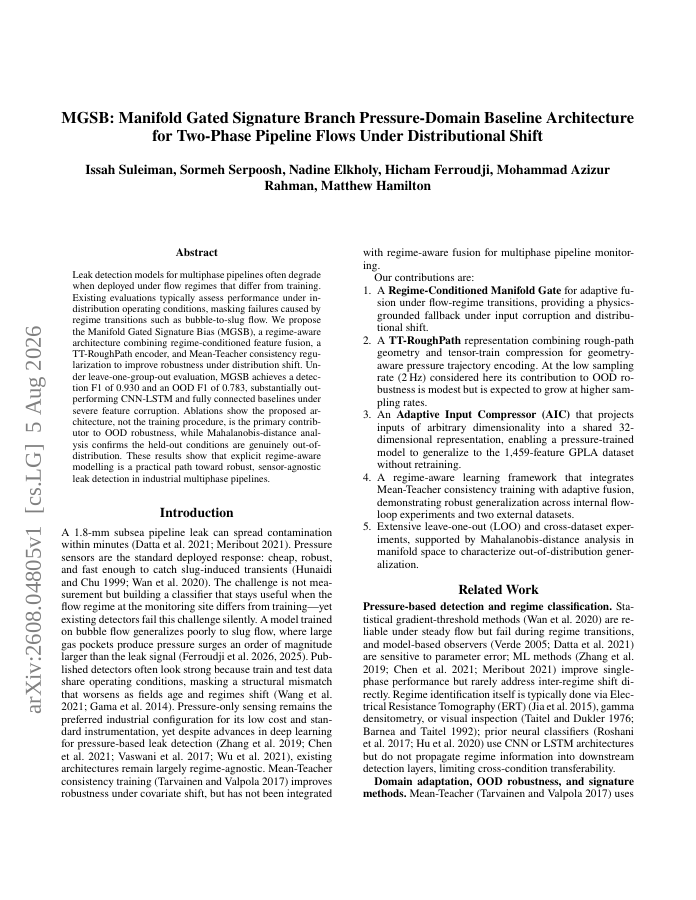
Leak detection models for multiphase pipelines often degrade when deployed under flow regimes that differ from training. Existing evaluations typically assess performance under in-distribution operating conditions, masking failures caused by regime transitions such as bubble-to-slug flow. We propose the Manifold Gated Signature Bias (MGSB), a regime-aware architecture combining regime-conditioned feature fusion, a TT-RoughPath encoder, and Mean-Teacher consistency regularization to improve robustness under distribution shift. Under leave-one-group-out evaluation, MGSB achieves a detection F1 of 0.930 and an OOD F1 of 0.783, substantially outperforming CNN-LSTM and fully connected baselines under severe feature corruption. Ablations show the proposed architecture, not the training procedure, is the primary contributor to OOD robustness, while Mahalanobis-distance analysis confirms the held-out conditions are genuinely out-of-distribution. These results show that explicit regime-aware modelling is a practical path toward robust, sensor-agnostic leak detection in industrial multiphase pipelines.
MGSB: Manifold Gated Signature Branch Pressure-Domain Baseline Architecture for Two-Phase Pipeline Flows Under Distributional Shift
Leak detection models for multiphase pipelines often degrade when deployed under flow regimes that differ from training. Existing evaluations typically assess performance under in-distribution operating conditions, masking failures caused by regime transitions such as…
- Preview
- Year
- 2026
- Hosting
- Full text hostedCC-BY-4.0
Cite
Notes
Only stored in your browser.
Attribution
- Abstract & full text
- arxiv.org/abs/2608.04805CC-BY-4.0
- TL;DR
- Semantic Scholar