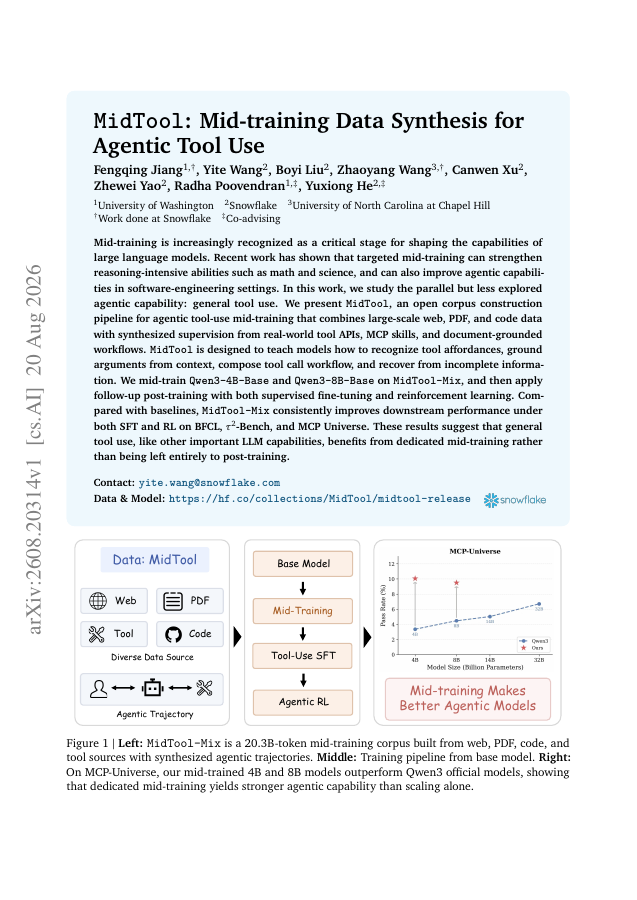
Mid-training is increasingly recognized as a critical stage for shaping the capabilities of large language models. Recent work has shown that targeted mid-training can strengthen reasoning-intensive abilities such as math and science, and can also improve agentic capabilities in software-engineering settings. In this work, we study the parallel but less explored agentic capability: general tool use. We present MidTool, an open corpus construction pipeline for agentic tool-use mid-training that combines large-scale web, PDF, and code data with synthesized supervision from real-world tool APIs, MCP skills, and document-grounded workflows. MidTool is designed to teach models how to recognize tool affordances, ground arguments from context, compose tool call workflow, and recover from incomplete information. We mid-train Qwen3-4B-Base and Qwen3-8B-Base on MidTool-Mix, and then apply follow-up post-training with both supervised fine-tuning and reinforcement learning. Compared with baselines, MidTool-Mix consistently improves downstream performance under both SFT and RL on BFCL, tau2-Bench, and MCP Universe. These results suggest that general tool use, like other important LLM capabilities, benefits from dedicated mid-training rather than being left entirely to post-training.
MidTool: Mid-training Data Synthesis for Agentic Tool Use
Mid-training is increasingly recognized as a critical stage for shaping the capabilities of large language models. Recent work has shown that targeted mid-training can strengthen reasoning-intensive abilities such as math and science, and can also improve agentic capabilities in…
- Preview
- Year
- 2026
- Hosting
- Full text hostedCC-BY-4.0
Cite
Notes
Only stored in your browser.
Attribution
- Abstract & full text
- arxiv.org/abs/2608.20314CC-BY-4.0
- TL;DR
- Semantic Scholar