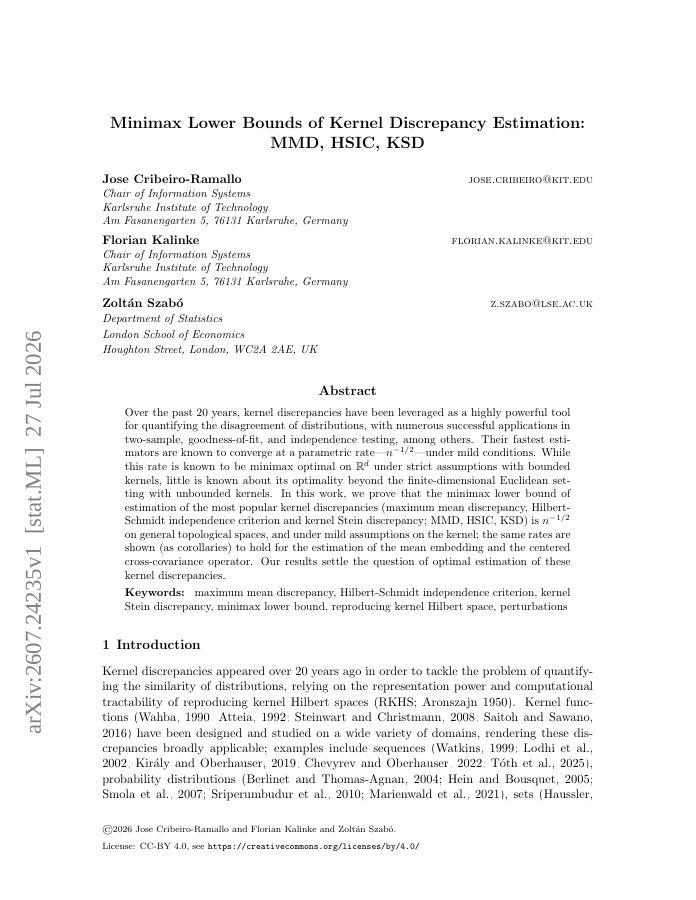
Over the past 20 years, kernel discrepancies have been leveraged as a highly powerful tool for quantifying the disagreement of distributions, with numerous successful applications in two-sample, goodness-of-fit, and independence testing, among others. Their fastest estimators are known to converge at a parametric rate---n^{-1/2}---under mild conditions. While this rate is known to be minimax optimal on \mathbb R^d under strict assumptions with bounded kernels, little is known about its optimality beyond the finite-dimensional Euclidean setting with unbounded kernels. In this work, we prove that the minimax lower bound of estimation of the most popular kernel discrepancies (maximum mean discrepancy, Hilbert-Schmidt independence criterion and kernel Stein discrepancy; MMD, HSIC, KSD) is n^{-1/2} on general topological spaces, and under mild assumptions on the kernel; the same rates are shown (as corollaries) to hold for the estimation of the mean embedding and the centered cross-covariance operator. Our results settle the question of optimal estimation of these kernel discrepancies.
Minimax Lower Bounds of Kernel Discrepancy Estimation: MMD, HSIC, KSD
Over the past 20 years, kernel discrepancies have been leveraged as a highly powerful tool for quantifying the disagreement of distributions, with numerous successful applications in two-sample, goodness-of-fit, and independence testing, among others.
- Preview
- Year
- 2026
- Hosting
- Abstract onlyARXIV-DEFAULT
Cite
Notes
Only stored in your browser.
Attribution
- Abstract & full text
- arxiv.org/abs/2607.24235ARXIV-DEFAULT
- TL;DR
- Semantic Scholar