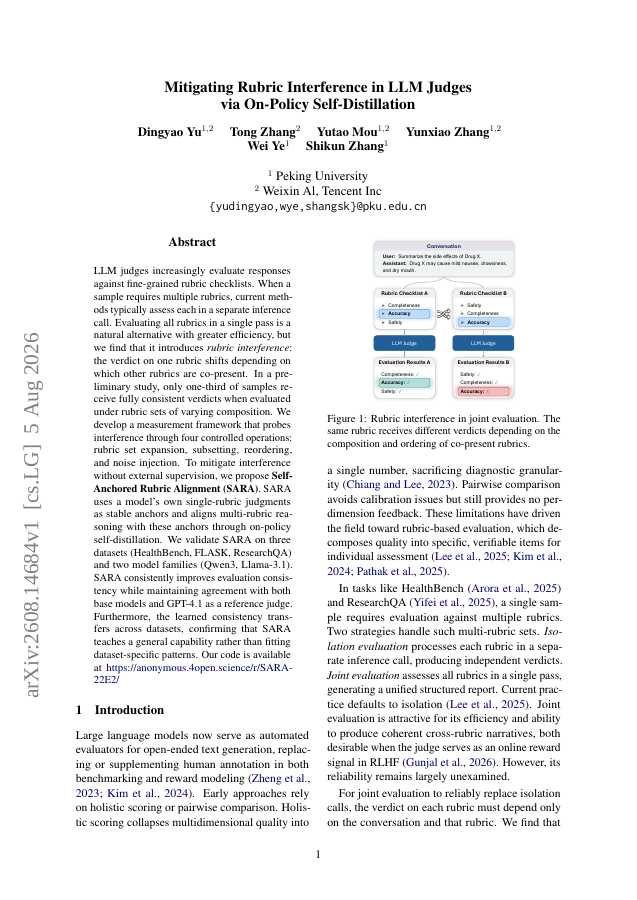
LLM judges increasingly evaluate responses against fine-grained rubric checklists. When a sample requires multiple rubrics, current methods typically assess each in a separate inference call. Evaluating all rubrics in a single pass is a natural alternative with greater efficiency, but we find that it introduces rubric interference: the verdict on one rubric shifts depending on which other rubrics are co-present. In a preliminary study, only one-third of samples receive fully consistent verdicts when evaluated under rubric sets of varying composition. We develop a measurement framework that probes interference through four controlled operations: rubric set expansion, subsetting, reordering, and noise injection. To mitigate interference without external supervision, we propose Self-Anchored Rubric Alignment (SARA). SARA uses a model's own single-rubric judgments as stable anchors and aligns multi-rubric reasoning with these anchors through on-policy self-distillation. We validate SARA on three datasets (HealthBench, FLASK, ResearchQA) and two model families (Qwen3, Llama-3.1). SARA consistently improves evaluation consistency while maintaining agreement with both base models and GPT-4.1 as a reference judge. Furthermore, the learned consistency transfers across datasets, confirming that SARA teaches a general capability rather than fitting dataset-specific patterns.
Mitigating Rubric Interference in LLM Judges via On-Policy Self-Distillation
LLM judges increasingly evaluate responses against fine-grained rubric checklists. When a sample requires multiple rubrics, current methods typically assess each in a separate inference call.
- Preview
- Year
- 2026
- Hosting
- Full text hostedCC0
Cite
Notes
Only stored in your browser.