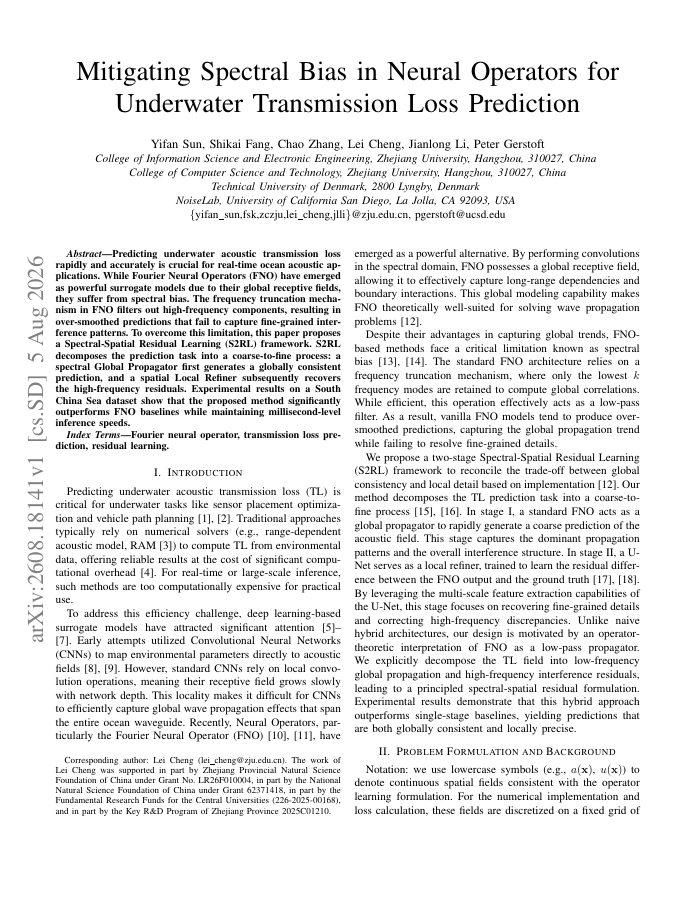
Predicting underwater acoustic transmission loss rapidly and accurately is crucial for real-time ocean acoustic applications. While Fourier Neural Operators (FNO) have emerged as powerful surrogate models due to their global receptive fields, they suffer from spectral bias. The frequency truncation mechanism in FNO filters out high-frequency components, resulting in over-smoothed predictions that fail to capture fine-grained interference patterns. To overcome this limitation, this paper proposes a Spectral-Spatial Residual Learning (S2RL) framework. S2RL decomposes the prediction task into a coarse-to-fine process: a spectral Global Propagator first generates a globally consistent prediction, and a spatial Local Refiner subsequently recovers the high-frequency residuals. Experimental results on a South China Sea dataset show that the proposed method significantly outperforms FNO baselines while maintaining millisecond-level inference speeds.
Mitigating Spectral Bias in Neural Operators for Underwater Transmission Loss Prediction
Predicting underwater acoustic transmission loss rapidly and accurately is crucial for real-time ocean acoustic applications. While Fourier Neural Operators (FNO) have emerged as powerful surrogate models due to their global receptive fields, they suffer from spectral bias.
- Preview
- Year
- 2026
- Hosting
- Full text hostedCC-BY-4.0
Cite
Notes
Only stored in your browser.
Attribution
- Abstract & full text
- arxiv.org/abs/2608.18141CC-BY-4.0
- TL;DR
- Semantic Scholar