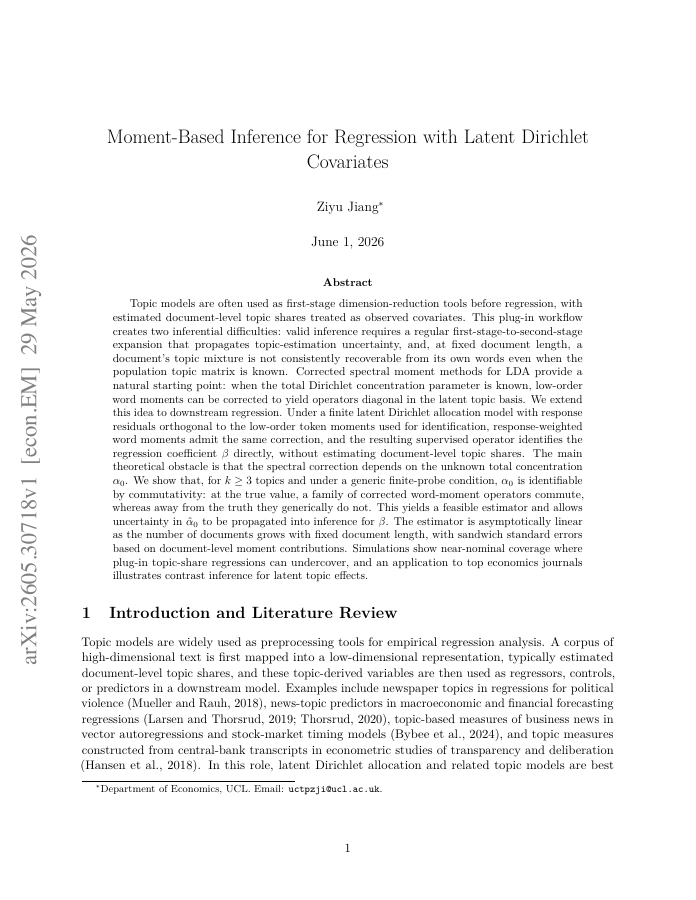
Topic models are often used as dimension-reduction tools before regression, with estimated document-level topic shares treated as observed covariates. This plug-in workflow creates two inferential difficulties: valid inference requires a regular first-stage-to-second-stage expansion that propagates topic-estimation uncertainty, and, at fixed document length, a document's topic mixture cannot be consistently recovered from its own words even when the population topic matrix is known. Corrected spectral moment methods for latent Dirichlet allocation (LDA) offer a starting point: when the total Dirichlet concentration is known, low-order word moments can be corrected to yield operators diagonal in the latent topic basis. We extend this to downstream regression. Under a finite LDA model with response residuals orthogonal to the low-order token moments used for identification, response-weighted word moments admit the same correction, and the resulting supervised operator identifies the regression coefficient β directly, without estimating document-level topic shares. The main obstacle is that the correction depends on the unknown total concentration α_0. We show that, for k\ge3 topics and under a generic finite-probe condition, α_0 is identified by commutativity: at the true value a family of corrected word-moment operators commute, whereas away from it they generically do not. This yields a feasible estimator and lets uncertainty in \hatα_0 propagate into inference for β. The estimator is asymptotically linear as the number of documents grows with fixed document length, with sandwich standard errors from document-level moment contributions. Simulations show near-nominal coverage where plug-in topic-share regressions can undercover, and an application to top economics journals illustrates contrast inference for latent topic effects.
Moment-Based Inference for Regression with Latent Dirichlet Covariates
Topic models are often used as dimension-reduction tools before regression, with estimated document-level topic shares treated as observed covariates. This plug-in workflow creates two inferential difficulties: valid inference requires a regular first-stage-to-second-stage…
- Preview
- Year
- 2026
- Hosting
- Abstract onlyARXIV-DEFAULT
Cite
Notes
Only stored in your browser.
Attribution
- Abstract & full text
- arxiv.org/abs/2605.30718ARXIV-DEFAULT
- TL;DR
- Semantic Scholar