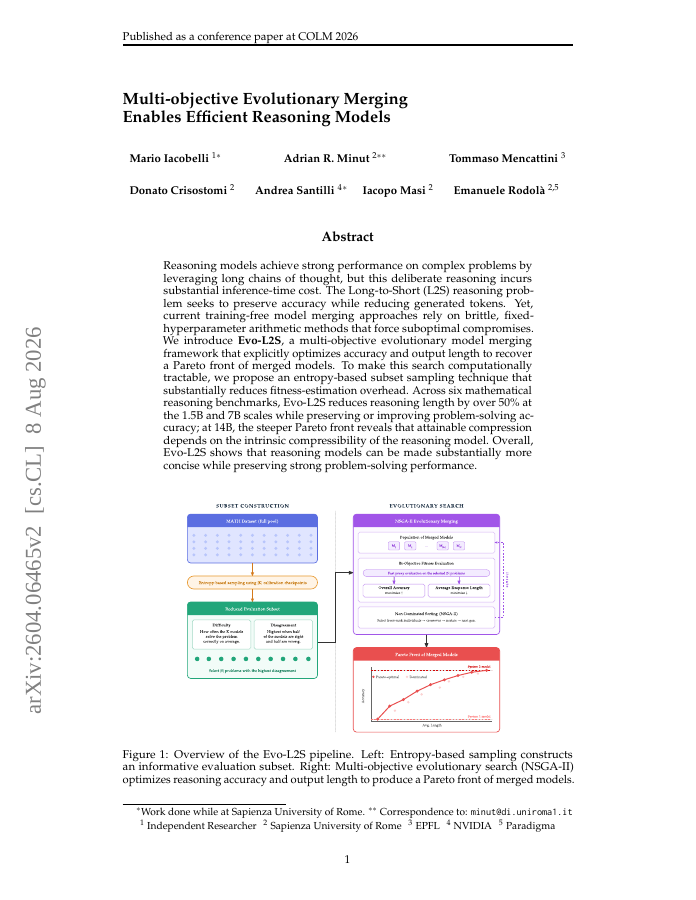
Reasoning models achieve strong performance on complex problems by leveraging long chains of thought, but this deliberate reasoning incurs substantial inference-time cost. The Long-to-Short (L2S) reasoning problem seeks to preserve accuracy while reducing generated tokens. Yet, current training-free model merging approaches rely on brittle, fixed-hyperparameter arithmetic methods that force suboptimal compromises. We introduce Evo-L2S, a multi-objective evolutionary model merging framework that explicitly optimizes accuracy and output length to recover a Pareto front of merged models. To make this search computationally tractable, we propose an entropy-based subset sampling technique that substantially reduces fitness-estimation overhead. Across six mathematical reasoning benchmarks, Evo-L2S reduces reasoning length by over 50% at the 1.5B and 7B scales while preserving or improving problem-solving accuracy; at 14B, the steeper Pareto front reveals that attainable compression depends on the intrinsic compressibility of the reasoning model. Overall, Evo-L2S shows that reasoning models can be made substantially more concise while preserving strong problem-solving performance.
Multi-objective Evolutionary Merging Enables Efficient Reasoning Models
Reasoning models achieve strong performance on complex problems by leveraging long chains of thought, but this deliberate reasoning incurs substantial inference-time cost. The Long-to-Short (L2S) reasoning problem seeks to preserve accuracy while reducing generated tokens.
- Preview
- Year
- 2026
- Hosting
- Excerpt onlyCC-BY-NC-SA-4.0
Cite
Notes
Only stored in your browser.
Attribution
- Abstract & full text
- arxiv.org/abs/2604.06465CC-BY-NC-SA-4.0
- TL;DR
- Semantic Scholar