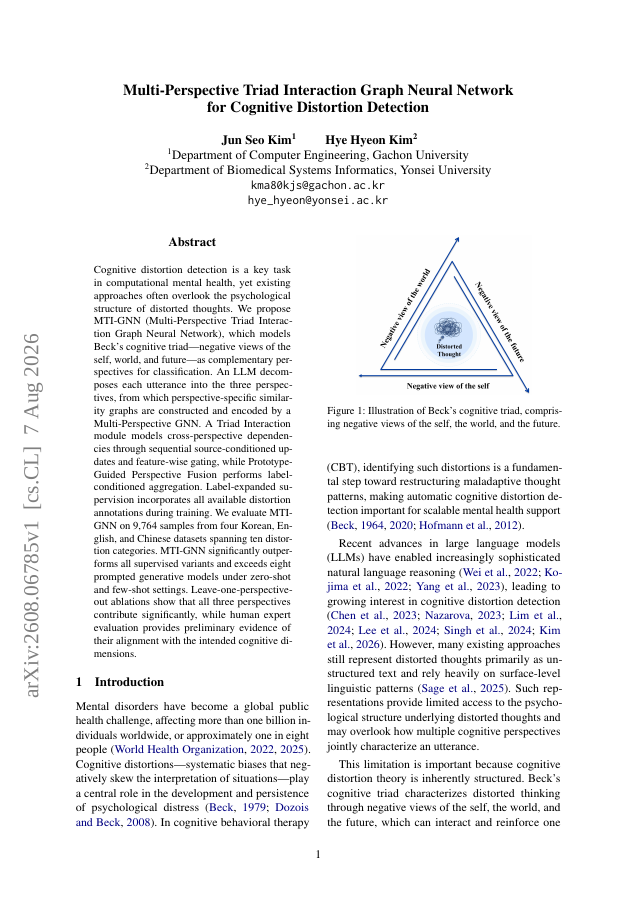
Cognitive distortion detection is a key task in computational mental health, yet existing approaches often overlook the psychological structure of distorted thoughts. We propose MTI-GNN (Multi-Perspective Triad Interaction Graph Neural Network), which models Beck's cognitive triad---negative views of the self, world, and future---as complementary perspectives for classification. An LLM decomposes each utterance into the three perspectives, from which perspective-specific similarity graphs are constructed and encoded by a Multi-Perspective GNN. A Triad Interaction module models cross-perspective dependencies through sequential source-conditioned updates and feature-wise gating, while Prototype-Guided Perspective Fusion performs label-conditioned aggregation. Label-expanded supervision incorporates all available distortion annotations during training. We evaluate MTI-GNN on 9,764 samples from four Korean, English, and Chinese datasets spanning ten distortion categories. MTI-GNN significantly outperforms all supervised variants and exceeds eight prompted generative models under zero-shot and few-shot settings. Leave-one-perspective-out ablations show that all three perspectives contribute significantly, while human expert evaluation provides preliminary evidence of their alignment with the intended cognitive dimensions.
Multi-Perspective Triad Interaction Graph Neural Network for Cognitive Distortion Detection
Cognitive distortion detection is a key task in computational mental health, yet existing approaches often overlook the psychological structure of distorted thoughts. We propose MTI-GNN (Multi-Perspective Triad Interaction Graph Neural Network), which models Beck's cognitive…
- Preview
- Year
- 2026
- Hosting
- Excerpt onlyCC-BY-NC-4.0
Cite
Notes
Only stored in your browser.
Attribution
- Abstract & full text
- arxiv.org/abs/2608.06785CC-BY-NC-4.0
- TL;DR
- Semantic Scholar