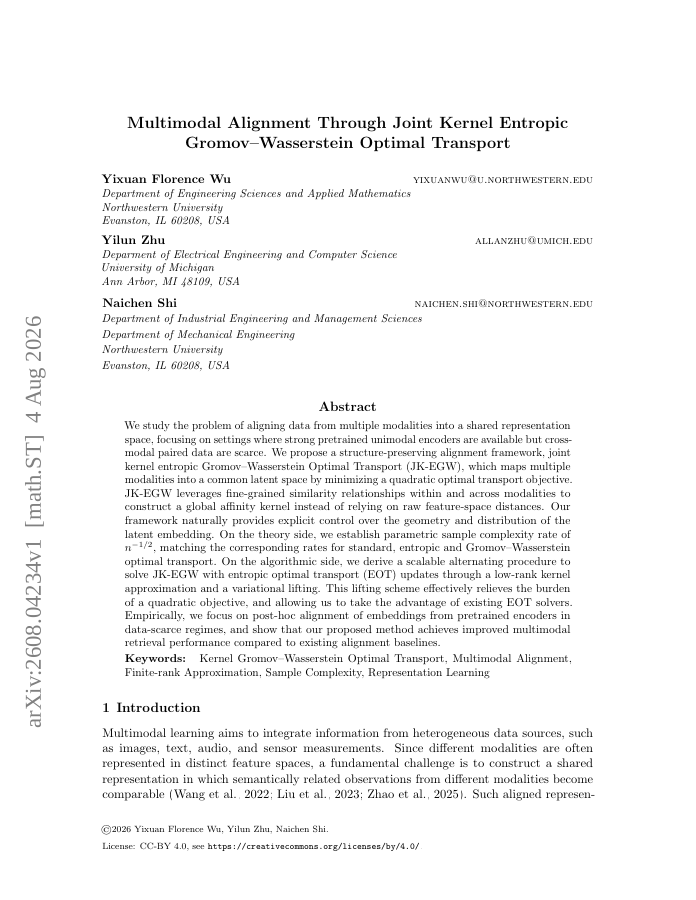
We study the problem of aligning data from multiple modalities into a shared representation space, focusing on settings where strong pretrained unimodal encoders are available but cross-modal paired data are scarce. We propose a structure-preserving alignment framework, joint kernel entropic Gromov--Wasserstein Optimal Transport (JK-EGW), which maps multiple modalities into a common latent space by minimizing a quadratic optimal transport objective. JK-EGW leverages fine-grained similarity relationships within and across modalities to construct a global affinity kernel instead of relying on raw feature-space distances. Our framework naturally provides explicit control over the geometry and distribution of the latent embedding. On the theory side, we establish parametric sample complexity rate of n^{-1/2}, matching the corresponding rates for standard, entropic and Gromov--Wasserstein optimal transport. On the algorithmic side, we derive a scalable alternating procedure to solve JK-EGW with entropic optimal transport (EOT) updates through a low-rank kernel approximation and a variational lifting. This lifting scheme effectively relieves the burden of a quadratic objective, and allowing us to take the advantage of existing EOT solvers. Empirically, we focus on post-hoc alignment of embeddings from pretrained encoders in data-scarce regimes, and show that our proposed method achieves improved multimodal retrieval performance compared to existing alignment baselines.
Multimodal Alignment Through Joint Kernel Entropic Gromov--Wasserstein Optimal Transport
We study the problem of aligning data from multiple modalities into a shared representation space, focusing on settings where strong pretrained unimodal encoders are available but cross-modal paired data are scarce.
- Preview
- Year
- 2026
- Hosting
- Full text hostedCC-BY-4.0
Cite
Notes
Only stored in your browser.
Attribution
- Abstract & full text
- arxiv.org/abs/2608.04234CC-BY-4.0
- TL;DR
- Semantic Scholar