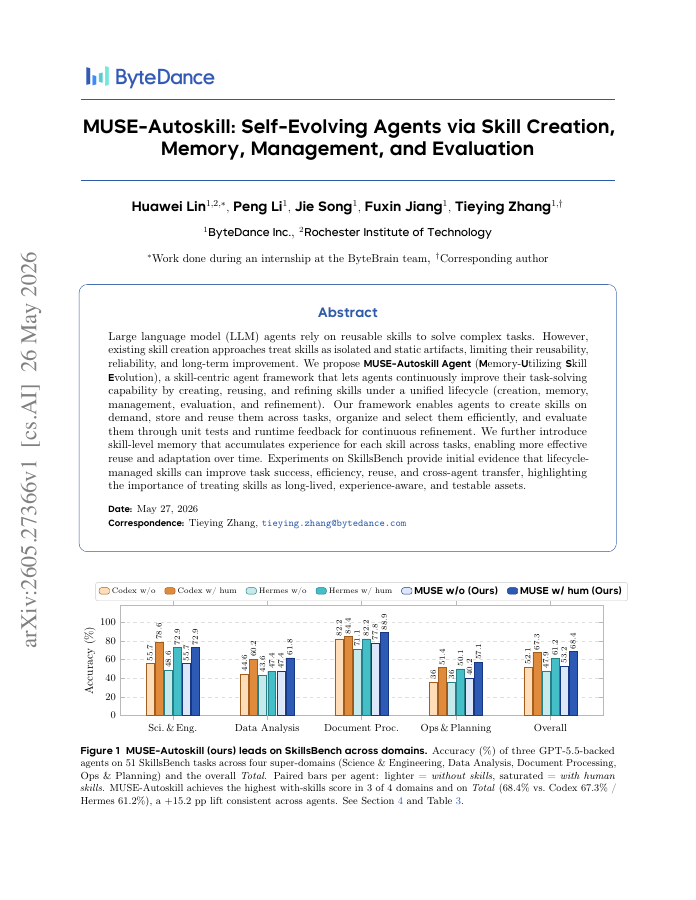
Large language model (LLM) agents rely on reusable skills to solve complex tasks, but existing skill creation approaches often treat skills as isolated, static artifacts, limiting reusability, reliability, and long-term improvement. We propose MUSE-Autoskill Agent (Memory-Utilizing Skill Evolution), a skill-centric agent framework that creates, reuses, and refines skills under a unified lifecycle: creation, memory, management, evaluation, and refinement. MUSE creates skills on demand, stores them across tasks, retrieves them through a skill catalog, and accumulates per-skill experience for later reuse and adaptation. Across the main reported settings on SkillsBench and SkillLearnBench, MUSE-Autoskill outperforms Hermes, Codex, and Claude Code. On SkillsBench, its self-created skills surpass human-authored skills on the successfully covered subset (85.24% vs. 81.17%), showing that lifecycle-managed skills can distill agent experience into highly effective reusable assets; MUSE-created skills also transfer to Hermes more effectively than Codex- or Claude-created skills, reaching 51.90% accuracy under transfer. These results highlight the importance of treating skills as long-lived, experience-aware, and testable assets.
MUSE-Autoskill: Self-Evolving Agents via Skill Creation, Memory, Management, and Evaluation
Large language model (LLM) agents rely on reusable skills to solve complex tasks, but existing skill creation approaches often treat skills as isolated, static artifacts, limiting reusability, reliability, and long-term improvement.
- Preview
- Year
- 2026
- Hosting
- Full text hostedCC-BY-4.0
Cite
Notes
Only stored in your browser.
Attribution
- Abstract & full text
- arxiv.org/abs/2605.27366CC-BY-4.0
- TL;DR
- Semantic Scholar