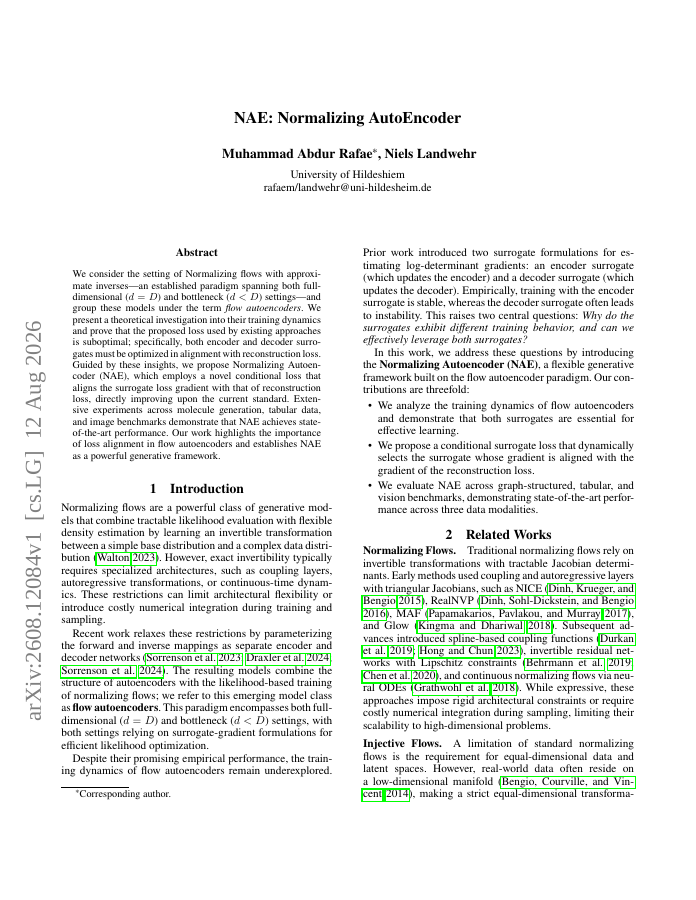
We consider the setting of Normalizing flows with approximate inverses, an established paradigm spanning both full-dimensional (d=D) and bottleneck (d<D) settings, and group these models under the term flow autoencoders. We present a theoretical investigation into their training dynamics and prove that the proposed loss used by existing approaches is suboptimal; specifically, both encoder and decoder surrogates must be optimized in alignment with reconstruction loss. Guided by these insights, we propose Normalizing Autoencoder (NAE), which employs a novel conditional loss that aligns the surrogate loss gradient with that of reconstruction loss, directly improving upon the current standard. Extensive experiments across molecule generation, tabular data, and image benchmarks demonstrate that NAE achieves state of the art performance. Our work highlights the importance of loss alignment in flow autoencoders and establishes NAE as a powerful generative framework.
NAE: Normalizing AutoEncoder
We consider the setting of Normalizing flows with approximate inverses, an established paradigm spanning both full-dimensional ($d=D$) and bottleneck ($d<D$) settings, and group these models under the term flow autoencoders.
- Preview
- Year
- 2026
- Hosting
- Full text hostedCC-BY-4.0
Cite
Notes
Only stored in your browser.
Attribution
- Abstract & full text
- arxiv.org/abs/2608.12084CC-BY-4.0
- TL;DR
- Semantic Scholar