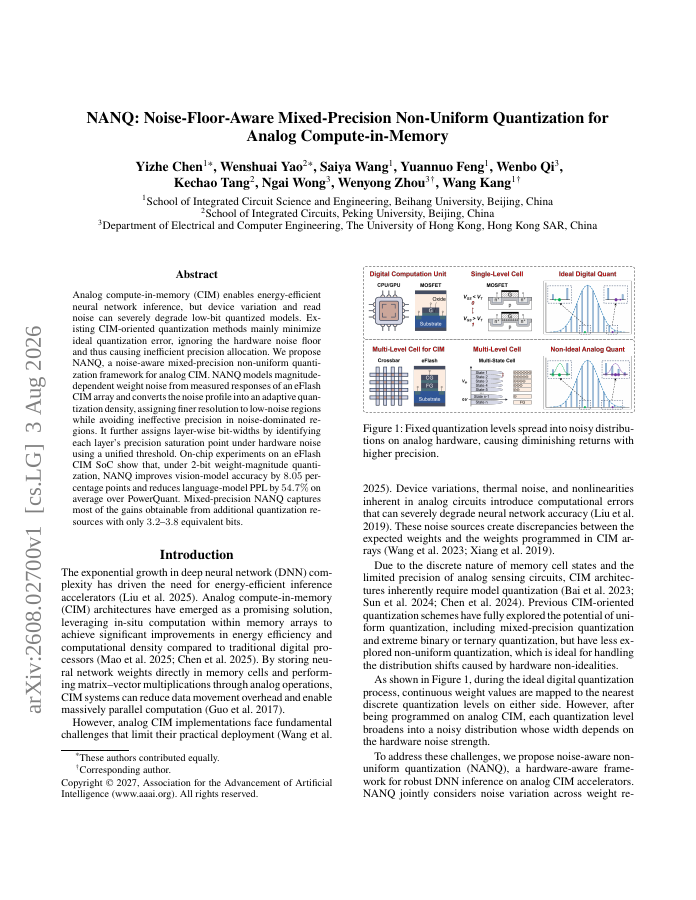
Analog compute-in-memory (CIM) enables energy-efficient neural network inference, but device variation and read noise can severely degrade low-bit quantized models. Existing CIM-oriented quantization methods mainly minimize ideal quantization error, ignoring the hardware noise floor and thus causing inefficient precision allocation. We propose NANQ, a noise-aware mixed-precision non-uniform quantization framework for analog CIM. NANQ models magnitude-dependent weight noise from measured responses of an eFlash CIM array and converts the noise profile into an adaptive quantization density, assigning finer resolution to low-noise regions while avoiding ineffective precision in noise-dominated regions. It further assigns layer-wise bit-widths by identifying each layer's precision saturation point under hardware noise using a unified threshold. On-chip experiments on an eFlash CIM SoC show that, under 2-bit weight-magnitude quantization, NANQ improves vision-model accuracy by 8.05 percentage points and reduces language-model PPL by 54.7% on average over PowerQuant. Mixed-precision NANQ captures most of the gains obtainable from additional quantization resources with only 3.2-3.8 equivalent bits.
NANQ: Noise-Floor-Aware Mixed-Precision Non-Uniform Quantization for Analog Compute-in-Memory
Analog compute-in-memory (CIM) enables energy-efficient neural network inference, but device variation and read noise can severely degrade low-bit quantized models. Existing CIM-oriented quantization methods mainly minimize ideal quantization error, ignoring the hardware noise…
- Preview
- Year
- 2026
- Hosting
- Abstract onlyARXIV-DEFAULT
Cite
Notes
Only stored in your browser.
Attribution
- Abstract & full text
- arxiv.org/abs/2608.02700ARXIV-DEFAULT
- TL;DR
- Semantic Scholar